Why Custom Duty Matters So Much in 2026
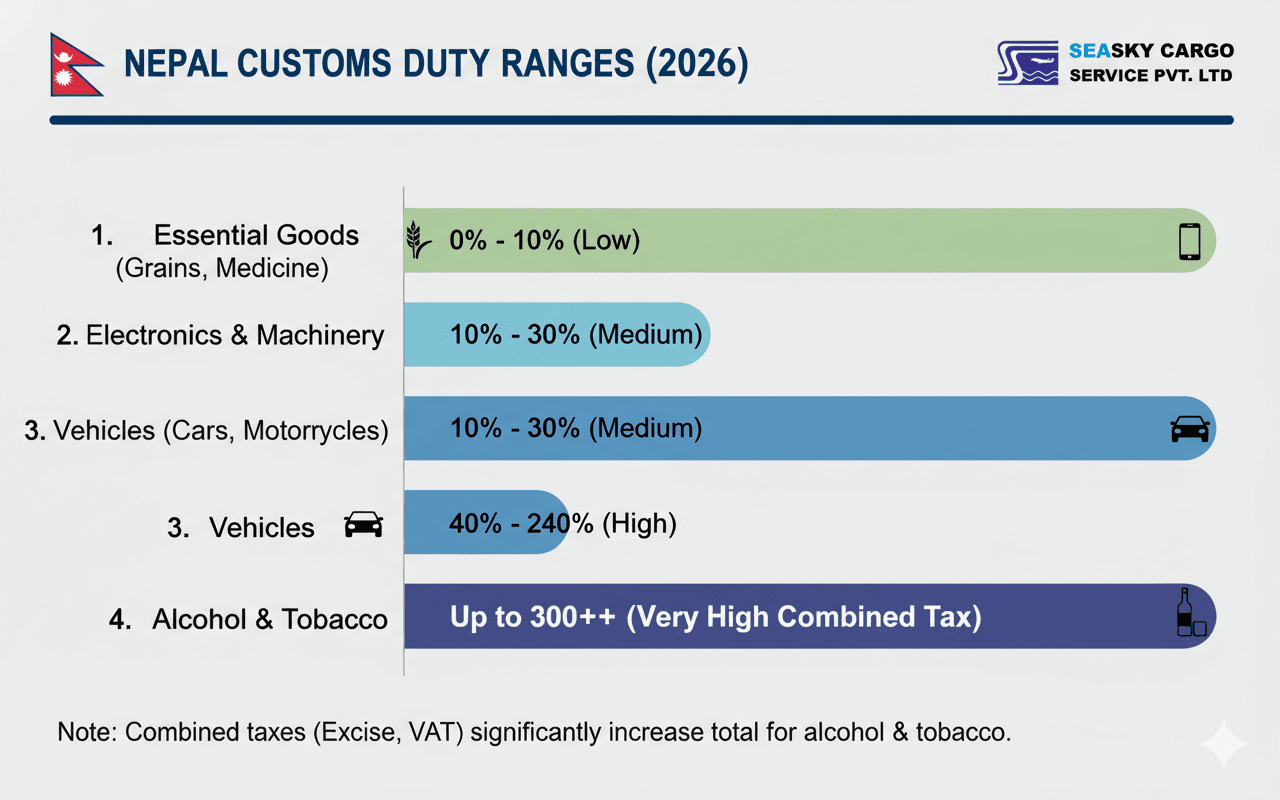
Customs duties and VAT remain the backbone of Nepal’s tax system. In the first month of FY 2082/83 (2025‑26), VAT and customs together contributed over 52% of total tax revenue, with VAT at Rs 27.6 billion (32.4%) and customs at Rs 16.6 billion (19.6%). In the first two months of FY 2082/83, VAT accounted for 32.9% (~Rs 52.14B) and customs 22.3% (~Rs 35.39B) of total revenue, and customs revenue grew 7.5% year‑on‑year.nepsetrading+3
This heavy dependence means:
- The government cannot afford to ignore customs when adjusting its budget.
- Importers feel every policy tweak directly in their landed costs.
- Exporters must know which inputs enjoy low duty and which finished goods face protective tariffs.
For 2026, the Finance Bill 2082/83 introduces targeted relief on essentials and industrial inputs while keeping (or raising) higher rates on luxury and non‑essential imports.
How Nepal Calculates Import Taxes
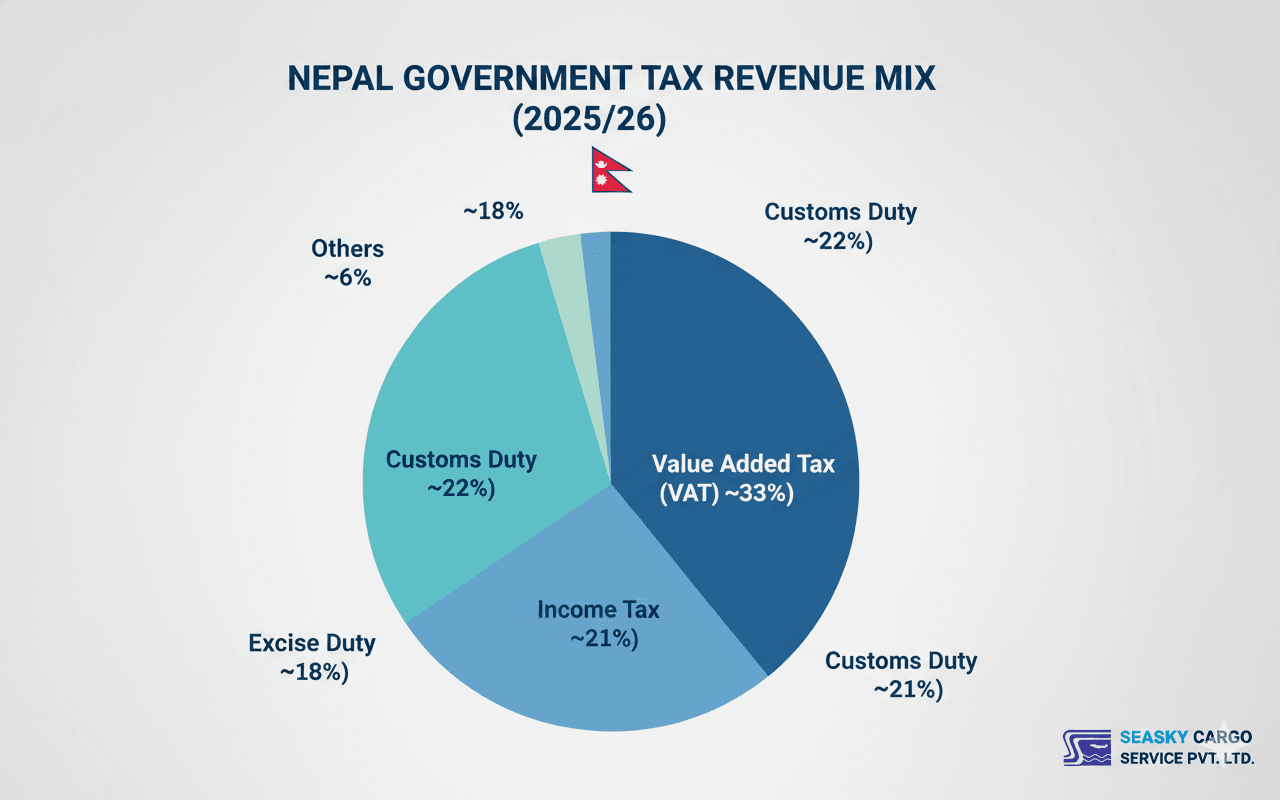
For importers, all major border taxes are layered on the CIF value (Cost + Insurance + Freight):
- Determine CIF value – the customs base.
- Apply custom duty on CIF, using the specific rate from the Integrated Tariff.
- Add excise duty, if applicable, on CIF + custom duty.
- Calculate VAT (13%) on CIF + custom duty + excise.
Formally:
- Customs duty = CIF × duty rate.
- Excise duty = (CIF + customs duty) × excise rate (if applicable).
- VAT = (CIF + customs duty + excise) × 13%.
- Total import tax = customs duty + excise + VAT.trade+1
Example from current guidance: a weaving machine with 5% customs duty attracts 13% VAT on CIF plus duty. Even with “just 5%” duty, the total tax burden becomes significantly higher once VAT is included.
Tariff Bands and Typical 2026 Rates
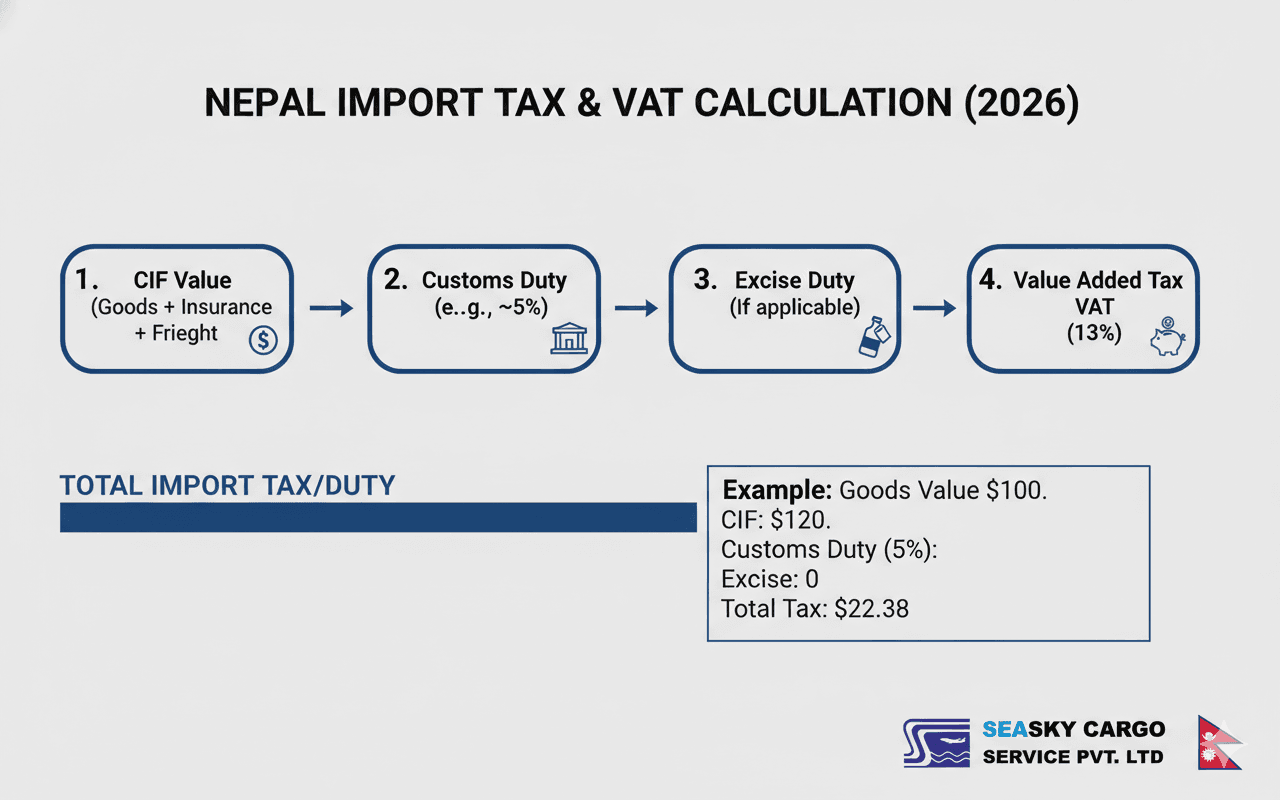
Nepal uses an integrated tariff schedule with banding categories. Overall, customs rates run from 0% to around 80%, with a two‑tier structure (lower rates for SAARC origin in many cases). Key 2026 patterns:
- Essential foods and farm inputs Often 0–10%. Finance Bill 2082/83 abolished advance income tax on imports of essential food grains, legumes, fruits, vegetables, livestock and dairy products, and provided 0–1% customs duty for some agricultural machinery and organic fertilizer equipment.sar+1
- Industrial raw materials, cotton, some chemicals Typically 5–10% duty with 13% VAT; excise usually not applied.companydartanepal+1
- Electronics – Many items like phones (HS 8517) sit around 10–30% duty plus VAT; 2082/83 budget added 10% customs duty on parts of electronic vapes that were previously exempt.pkf.trunco+1
- Vehicles – Among the highest: 40–240% customs duty on cars depending on engine size, type, fuel, and age, plus excise and VAT, making total tax several times the CIF cost.
- Alcohol and tobacco – 30–100% customs plus specific excise (e.g., Rs 500/litre on beer) and 13% VAT, reflecting revenue and health objectives.nbsm+1
For exporters, this structure matters because:
- Low‑duty raw materials make processing in Nepal more attractive.
- High duties on finished consumption goods create a protection wall your Nepal‑made products can benefit from.
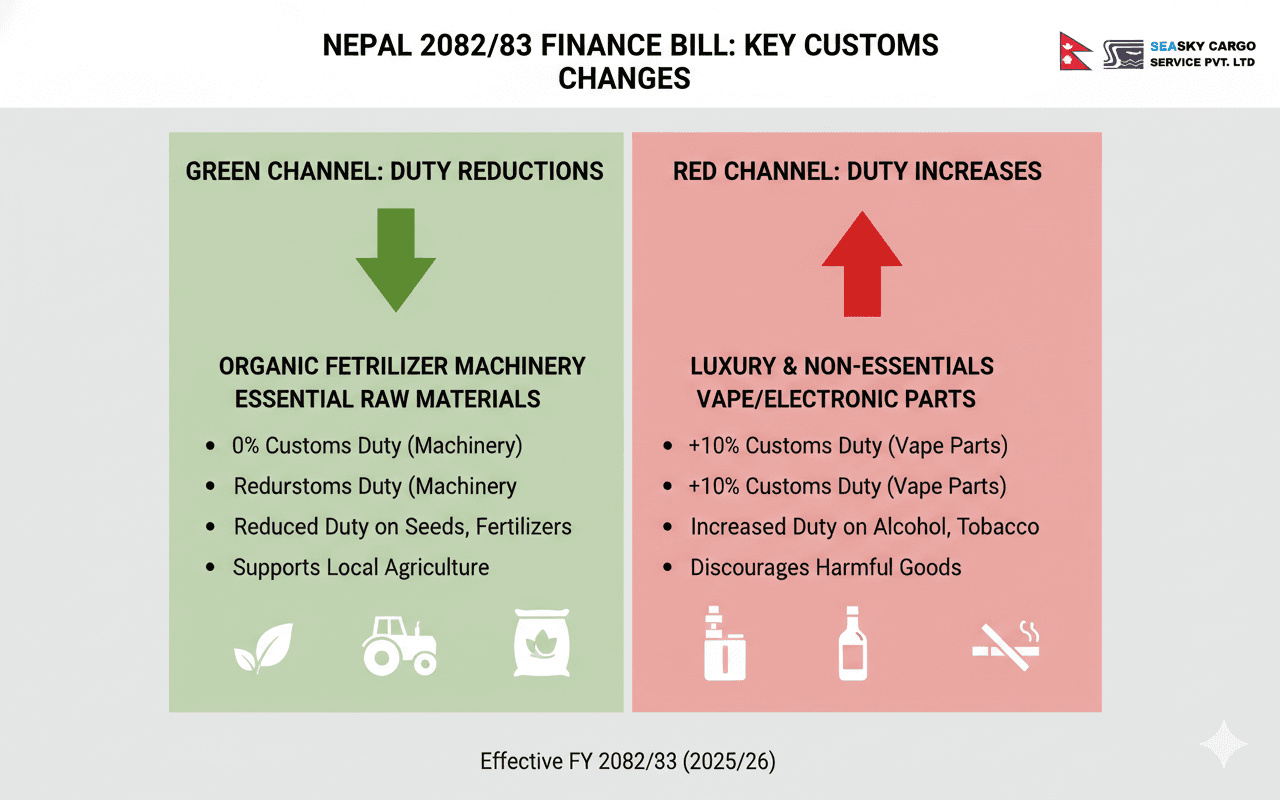
2026 Budget and Finance Bill 2082/83: What Changed`
The Budget 2082/83 (2025‑26) and related Finance Bills modify customs in several strategic areas:
- Agriculture & fertilizer:
- Customs duties and excise were removed on machinery for producing organic and natural fertilizers.
- Some fertilizer‑related equipment now enters at 1% customs duty with exemption from other taxes, supporting domestic production.
- Essential goods relief:
- Advance income tax at the customs point was abolished for essential goods, including food grains, legumes, fruits, vegetables, livestock and dairy products. This immediately reduces working‑capital pressure for importers in these sectors.
- Customs valuation reform:
- The Department of Customs is developing an internal international price database, gradually replacing manual “reference pricing” with automated valuation to improve transparency and reduce disputes.seaskycargoservice+1
- Targeted increases:
- Customs duty @10% on parts of electronic vaping equipment which were previously duty‑free, reflecting health/revenue motives.
Together, these adjustments lower costs for productive sectors and essentials, while tightening control and increasing customs take on non‑essential or risky items. Exporters should track which inputs are now cheaper; importers must watch new duty lines.
Where Zero and Low Duties Really Apply
Despite headlines about high tariffs, a significant share of imports enter on low rates:
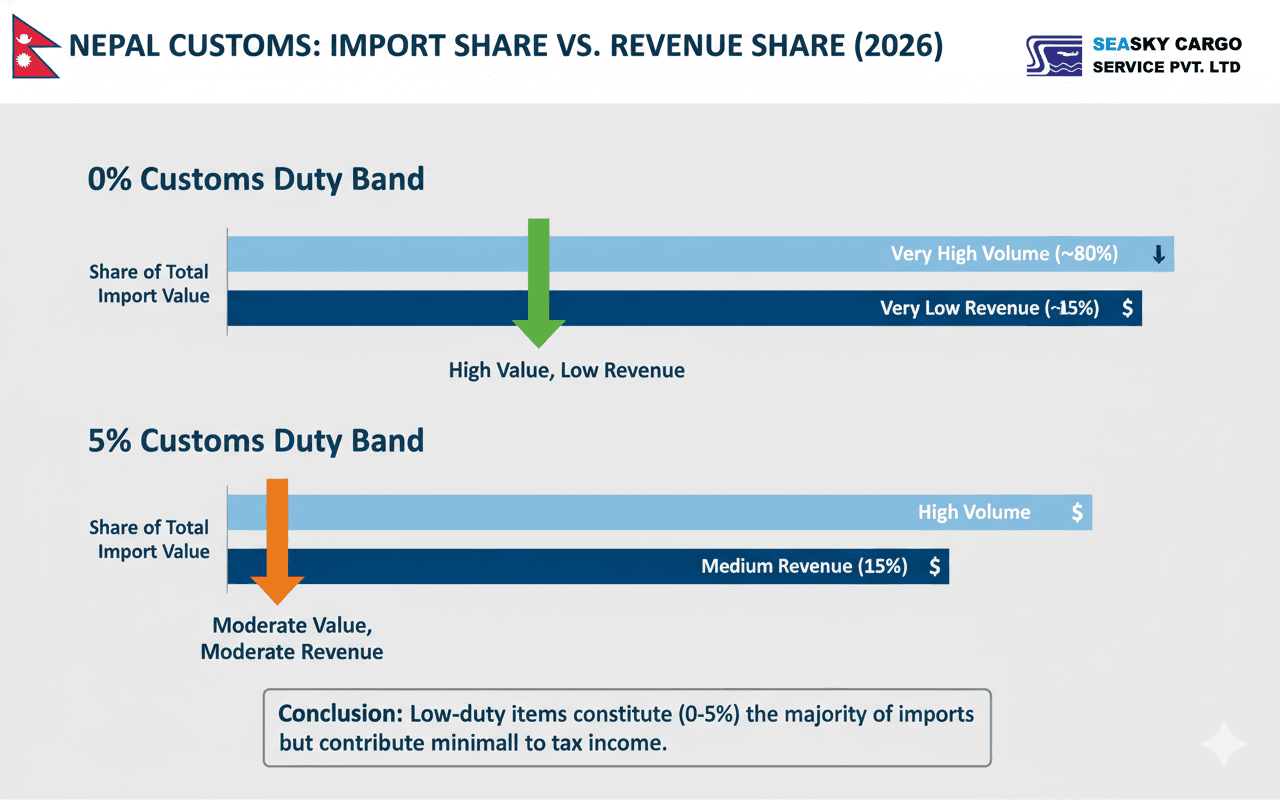
- In the first month of FY 2082/83, about 10.55% of imports came in at 0% duty, and 20.87% of import value was taxed at only 5% duty, yet this bracket contributed just 7.91% of total customs revenue.
This means most customs income is concentrated in the higher bands, while low‑ and zero‑duty lines quietly support:
- Industrial raw materials and machinery.
- Essential foods and medicines.
- Inputs meant to stimulate domestic value‑addition.
For exporters, using these low‑duty channels to bring in inputs, then re‑exporting value‑added outputs, can significantly improve margin. For importers, identifying HS codes that qualify for 0–5% rates is key to staying price‑competitive.
Customs and VAT as Revenue Pillars
Recent fiscal data show:
- In early FY 2082/83, VAT ~33% and customs ~22% of total revenue; excise ~18%, income tax ~21%.
- In the first month alone, VAT and customs totaled 52% of tax revenue, even though overall collections fell 10.5% year‑on‑year.vatupdate+1
For businesses, this implies:
- Policy will continue to lean on imports and consumption for revenue.
- Sudden import controls or duty hikes are possible during external shocks.
- However, there is also pressure to rationalize and simplify customs, evidenced by valuation reforms and targeted duty cuts on productive sectors.
Exporters and importers should thus:
- Monitor each year’s budget speech and Finance Bill.
- Build in duty change scenarios when pricing long‑term contracts.
- Consider bonded or special schemes if available for export‑oriented units.
Practical Tips for Importers in 2026
To keep landed costs under control and avoid clearance headaches:
- Classify correctly:
Use the official integrated tariff (Department of Customs site or National Single Window) to find accurate HS codes and duty rates. - Check tariff bands & SAARC rates:
SAARC‑origin goods often enjoy lower rates structure your sourcing to leverage regional preferences where possible. - Use low‑duty inputs:
Shift procurement towards items in 0–5% bands, such as certain raw materials and machinery, when technically feasible. - Watch exemptions and incentives:
2082/83 offers 1% duty and tax exemptions for organic fertilizer machinery and some farm inputs; more sector‑specific reliefs may exist in the budget and Tax Fact documents. - Budget for non‑duty costs:
Port/handling charges, documentation fees, and compliance costs can be significant plan beyond the headline tariff rate.
Practical Tips for Exporters in 2026
For exporters, the customs/tariff environment matters in two ways: input cost and international market access.
- Optimize input sourcing:
- Use low‑duty raw materials and machinery to reduce cost of goods sold.
- Explore duty exemptions for export‑oriented industries when available.
- Plan for LDC graduation:
- Studies estimate 4.3% export loss (~$59M) once EBA benefits phase out, but GSP and other schemes will keep a large share of preferences.tradebriefs.intracen+1
- Work with buyers to understand new tariff implications in the EU and other markets and adjust pricing/volumes early.
- Leverage regional value chains:
- Cumulate value with India and other neighbors to meet GSP rules of origin while keeping input costs low.
- Document cleanly for rebates:
- Where duty drawback or export incentives are offered, accurate customs documentation is essential to claim them.
Key Takeaways for 2026
- Customs duty in Nepal ranges roughly 0–80%, but 0–5% bands account for over 30% of import value while contributing far less to revenue, indicating a deliberate pro‑input policy.
- VAT remains 13%, applied on top of customs duty and excise as part of a layered tax structure.
- The 2082/83 budget cuts duties for organic fertilizer machinery and essentials and removes advance income tax on key food items, but adds new duties on vapes and maintains high rates on vehicles and luxury goods.
- Customs and VAT together are over half of government tax revenue, which makes policy stable in direction but vulnerable to trade shocks businesses must always watch the budget cycle closely.
For both exporters and importers, 2026 is a year to take customs seriously as part of strategic planning not just as a last‑minute calculation at the border. Understanding the structure, the new incentives, and the risk areas will help you price correctly, stay compliant, and protect your margins in a system that the government relies on more than ever.
Related posts
1970-01-01
Sea + Air Freight: How SeaSky Helps Businesses Ship Smarter
2026-10-12
B2B Logistics in Nepal: Cross-Border Delivery for Businesses

2026-10-12
France to Nepal Shipping Guide: Air Freight, Sea Freight, Customs and Documents

2026-10-08