
Use the 2083/84 tariff before placing the order
Before importing goods into Nepal, calculate more than the supplier price and main freight. The likely HS code, accepted customs value, customs duty, VAT, excise, permits and destination charges can all change the landed cost.
Nepal’s Department of Customs has published the Integrated Customs Tariff 2083/84 for fiscal year 2026/27. Use the current official tariff and later government notices for the transaction date. An old PDF, a supplier’s code or a previous shipment can support research, but none of them is a final assessment for new cargo.
Importers commonly search for the same information as Nepal bhansar rate, custom tariff Nepal, HS code Nepal, import duty Nepal or integrated customs tariff. The official schedule is the controlling starting point; the product facts and applicable law decide which entry is relevant.
This guide shows how to research the tariff, build an early estimate and prepare the evidence that a customs representative may need. For a detailed landed-cost worksheet, also read how to calculate import duty in Nepal.
Important: duty rates, classifications, exemptions and government charges can change. Nepal Customs and other competent authorities make the final classification, valuation, inspection and release decisions.

What Nepal Customs Tariff 2083/84 contains
Fiscal year 2083/84 is the Nepal fiscal period commonly described as 2026/27. The integrated tariff organizes goods by classification and brings together the rate information and notes needed for import research.
A tariff entry may show or help identify:
- HS heading, subheading and national tariff code
- Official product description
- Unit of measurement
- Customs-duty treatment
- Excise treatment where applicable
- VAT treatment or exemption references
- Conditions, footnotes, concessions or restrictions
- Other product-specific levies or legal references
Read the complete entry and its notes. A percentage in one column does not by itself give the total import cost, and a zero customs-duty entry does not automatically mean the transaction is free from VAT, excise, permits or logistics charges.
Use the official Department of Customs tariff page to find the current 2083/84 publication. Record the source and the date you checked it so the purchasing file shows which schedule supported the estimate.
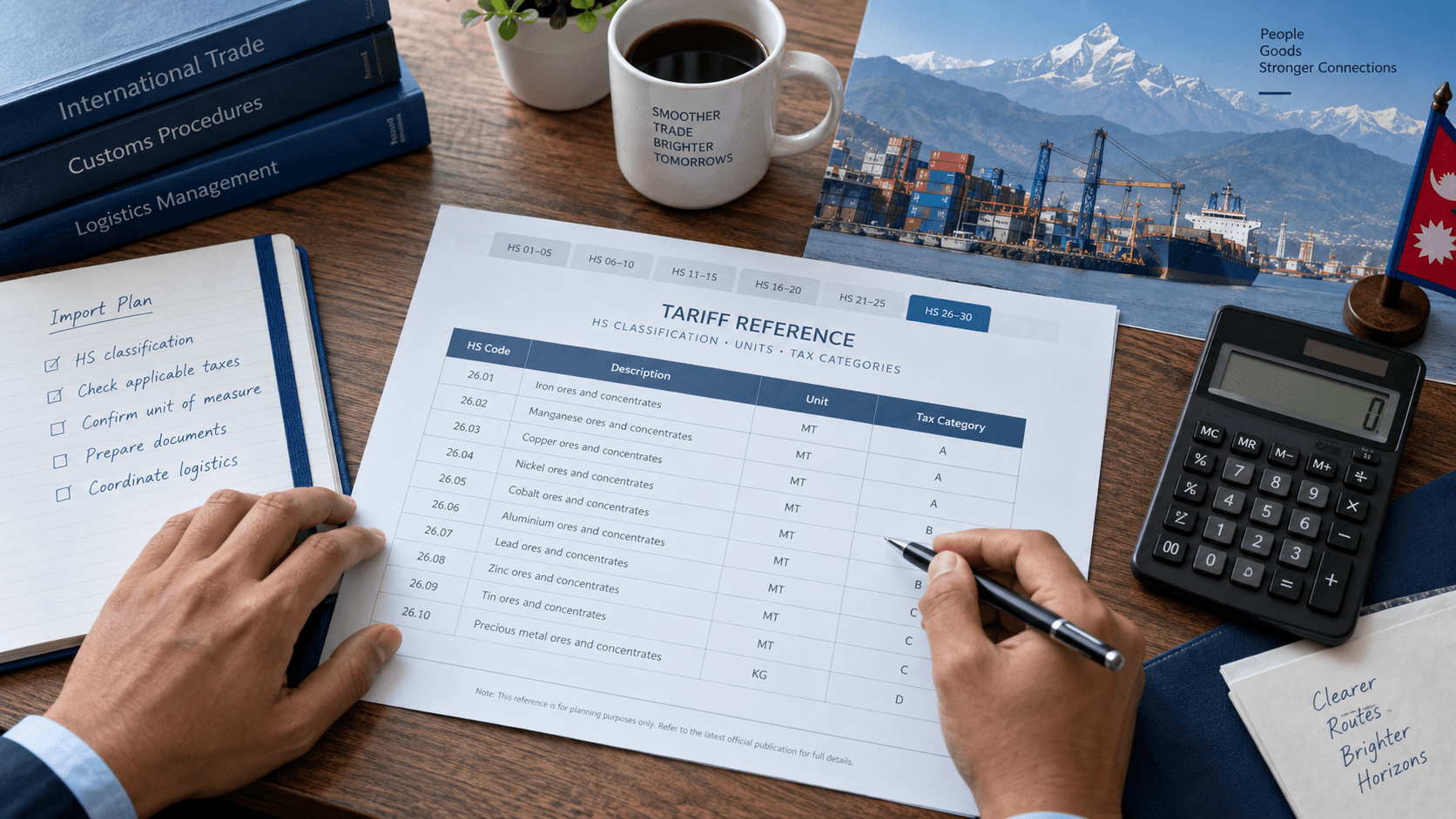
How HS codes affect duty, permits and clearance
The Harmonized System, or HS, classifies goods for customs and trade. The first six digits are internationally harmonized, while additional national digits can identify more specific tariff lines. The code used for a Nepal declaration must match the actual goods and the current Nepal tariff structure.
Classification can depend on:
- What the product is and what it does
- Its principal material or composition
- Whether it is complete, unfinished, a part or an accessory
- Capacity, power, voltage, engine size or other technical characteristics
- How it is packaged or presented
- Relevant section, chapter and explanatory notes
The selected code may affect customs duty, VAT, excise, licence requirements, certificates, inspection and eligibility for a concession. Marketing names are rarely enough. “Machine parts,” “electronics” and “plastic goods” do not identify the material, function or technical features needed for a defensible classification.
A supplier’s HS code is useful evidence, but it may reflect another country’s national tariff or a different interpretation. Review it for the Nepal transaction. The wrong HS code guide explains the operational and cost consequences of a poor classification.

How to research the likely HS code
Prepare the product facts before opening the tariff. Classification research becomes much faster when the commercial team, supplier and customs specialist are discussing the same item. Good descriptions name the product, material and function: “stainless-steel water storage tank,” “rechargeable lithium-ion battery pack” or “industrial electrical control panel.” Keep catalogues, photographs, data sheets and composition records with the classification note. If two entries remain plausible, do not choose the lower rate merely because it is cheaper. Ask the responsible customs professional to review the competing headings and the legal notes before the supplier ships.
| Research step | Information to collect | Why it matters |
|---|---|---|
| 1. Describe the product | Plain-language name and exact use | Separates the product from broad marketing labels |
| 2. Identify material | Composition and material giving essential character | Many headings are organized by material |
| 3. Explain function | What the item does and where it is used | Function can determine the relevant chapter or heading |
| 4. Add specifications | Model, power, capacity, size and operating method | Distinguishes nearby tariff entries |
| 5. Define condition | Complete, unassembled, unfinished, part or accessory | Presentation can change classification |
| 6. Search the tariff | Candidate heading, nearby entries and legal notes | Prevents selecting the first keyword result |
| 7. Check controls | Licence, recommendation, certificate or restriction | Identifies pre-shipment approvals |
| 8. Confirm uncertainty | Catalogue, photo and technical evidence | Supports review before dispatch |

How to estimate customs duty, VAT and excise
Start with a supported customs-value estimate. Depending on the transaction and applicable valuation rules, this can involve the genuine goods value plus relevant freight, insurance and other dutiable additions. Customs decides the accepted value and may request payment, transport or catalogue evidence. The Internal Revenue Department states a standard VAT rate of 13%, but product-specific exemption or treatment still needs to be checked. Excise can depend on the commodity and technical characteristics, so it should not be assumed from the customs-duty percentage. A freight quotation and a government-tax estimate answer different questions. Keep origin charges, main carriage, terminal handling, customs-agent fees, storage, inspection and delivery visible rather than hiding them inside one “all-in” number.
| Step | Planning formula | Check before using it |
|---|---|---|
| Customs value | Goods value + relevant freight + insurance + applicable additions | Use real transaction evidence and the proper exchange rate |
| Customs duty | Accepted customs value × verified tariff rate | Match the current 2083/84 line and conditions |
| Excise | Applicable excise base × product-specific rate | Confirm whether excise applies and its legal base |
| VAT base | Customs value + duty + applicable excise + other taxable amounts | Use the legally applicable import base |
| VAT | VAT base × applicable VAT rate | The standard rate is 13% as of September 2026; exemptions may apply |
| Government subtotal | Duty + excise + VAT + other applicable levy | Keep government charges separate from services |
| Landed cost | Goods + logistics + government charges + clearance + delivery | Add storage and delay exposure separately |

Need an import-cost review before you order?
Share the product specification, origin, packing, value and proposed route. Sea Sky can help organize the customs and logistics questions before dispatch.
Illustrative landed-cost example
The example below demonstrates the arithmetic only. It is not an official rate, quotation or tax ruling. The 10% customs-duty rate and zero excise are assumptions chosen only to show the calculation. A real product may have a different duty rate, excise basis, VAT status, valuation adjustment, concession, levy or exchange-rate treatment. This table also excludes clearance fees, terminal handling, storage, banking, inspection and delivery. Before buying, recalculate with the verified HS code, current rates, final packing, confirmed freight, applicable Incoterm and a sensible delay contingency.
| Illustrative item | Amount |
|---|---|
| Product value | NPR 100,000 |
| Freight and insurance used for planning | NPR 10,000 |
| Planning customs value | NPR 110,000 |
| Assumed customs-duty rate | 10% |
| Illustrative customs duty | NPR 11,000 |
| Assumed excise | NPR 0 |
| Illustrative VAT base | NPR 121,000 |
| VAT at 13% | NPR 15,730 |
| Illustrative government-charge subtotal | NPR 26,730 |
| Value plus illustrated government charges | NPR 136,730 |
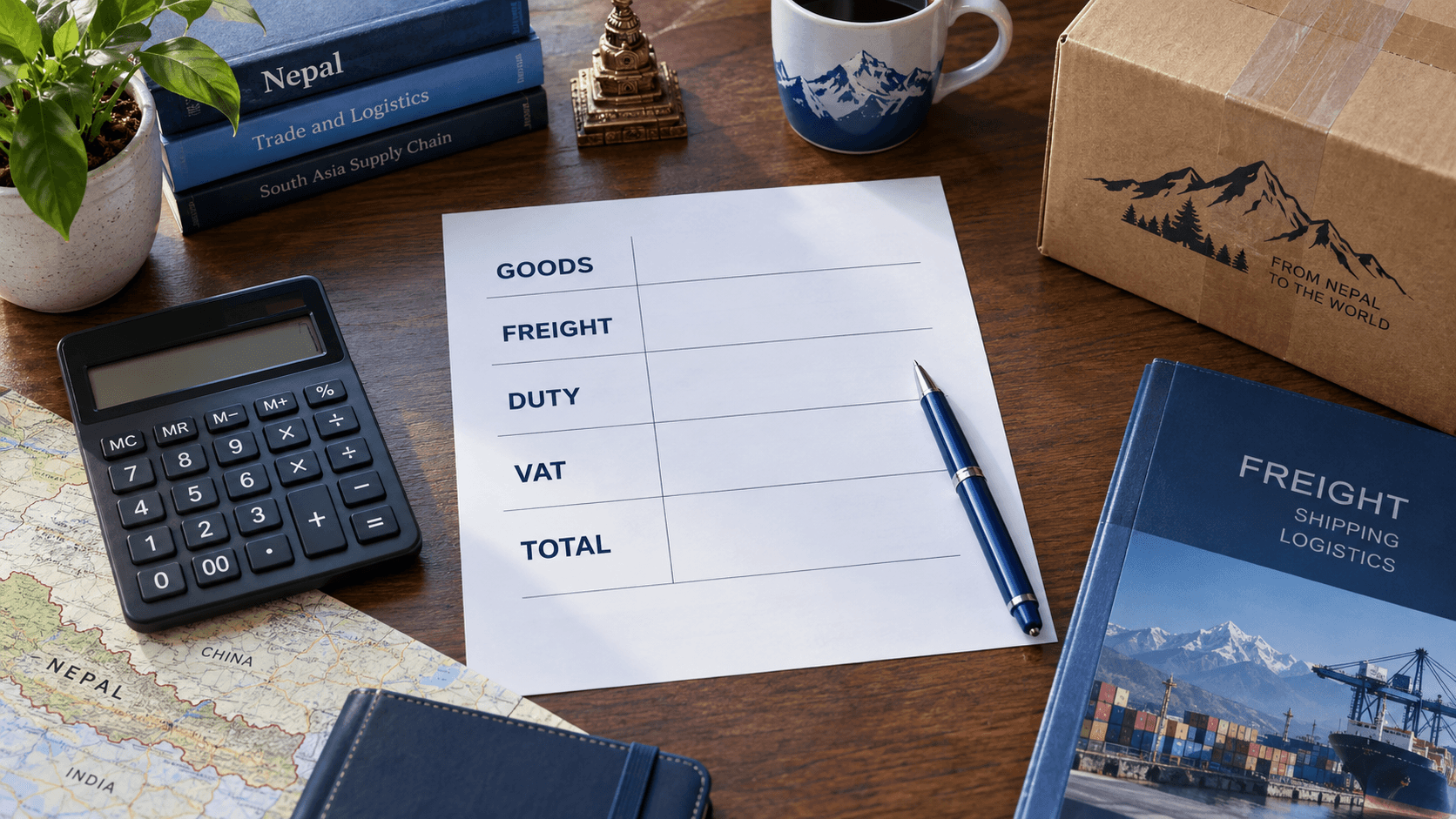
Check the latest tariff, notices and product rules
A downloaded tariff is a dated source. Before relying on it, check the fiscal year, publication details, HS-code format, complete product description, unit, rate columns, footnotes and any later government notice.
Give additional attention to vehicles, batteries, medicines, food, agricultural goods, chemicals, cosmetics, telecom or wireless equipment, controlled goods and used products. These categories can involve technical thresholds, recommendations, registrations, certificates or restrictions beyond the tariff rate.
- Use the Department of Customs 2083/84 integrated tariff, not an undated copy from a third party
- Check whether a budget measure or later notification changes the tariff entry
- Confirm whether a preferential or concessional rate has eligibility conditions
- Match the declared unit and quantity to the tariff entry
- Verify the importer’s EXIM registration and the product-specific approval path
- Record who checked the rate and when it was checked
The Department of Customs maintains the official tariff publication and the EXIM portal for importer/exporter registration services. The exact import file still depends on the goods, transaction, route and responsible authority.
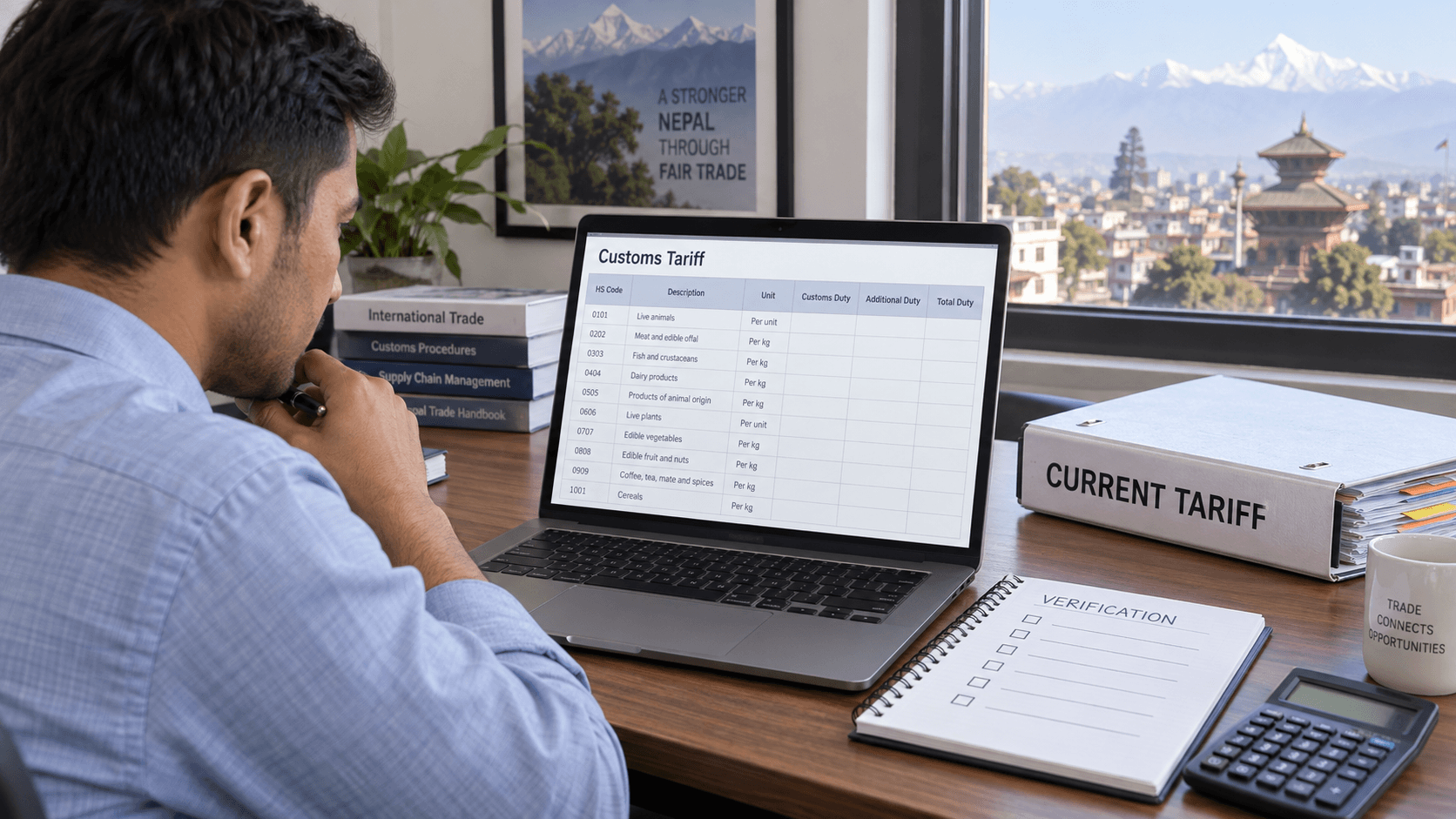
Documents to prepare before the supplier dispatches
Prepare the customs and transport file while the goods remain with the supplier. Corrections are usually easier before a carrier issues the transport document or the cargo reaches a Nepal entry point. Descriptions, quantities, values, model numbers, package counts and weights should agree across the file. The import permit guide helps identify checks that belong before shipment, while the customs-clearance agent guide explains how to prepare for clearance support. If an authorized agent will file or coordinate the declaration, prepare the required authorization and keep the responsible importer’s details consistent. A forwarder can organize the file, but it does not replace the legal responsibility of the declarant or the authority of Customs.
| Document or evidence | Details to match |
|---|---|
| Commercial invoice | Seller, buyer, product, quantity, unit value, currency and Incoterm |
| Packing list | Packages, contents, dimensions, net and gross weight and marks |
| Transport instructions | Shipper, consignee, notify party, route and cargo description |
| Classification evidence | Catalogue, specification, composition, model and photographs |
| Origin evidence | Certificate or declaration when required |
| Permit or recommendation | Importer, product, quantity, validity and conditions |
| Insurance record | Cargo, value, packages, route and insured party |
| Banking or payment file | Purchase order, remittance or letter-of-credit records as applicable |
| Importer records | EXIM, PAN or VAT details and authorization as applicable |

Common tariff mistakes and the pre-order checklist
Most avoidable customs problems start before the goods move. A vague product description produces a weak HS-code estimate; an old tariff produces the wrong rate; and an incomplete Incoterm hides freight or destination costs. Before approving the purchase: Collect the exact description, use, composition, model and photographs Identify and review the likely HS code Check the current tariff line, notes and unit Verify duty, VAT, excise and other applicable levies Confirm permits, registrations, recommendations and certificates Align the invoice, packing list and shipping instructions Compare the route and Incoterm on a complete landed-cost basis Record sources, dates, assumptions, exclusions and contingency Request professional review where classification or admissibility remains uncertain Online calculators are useful for early budgeting, but they cannot inspect the goods or issue a binding classification. Use them to model scenarios, then replace assumptions with current verified information.
| Common mistake | Better control |
|---|---|
| Using the supplier’s code without review | Check product facts against Nepal’s current tariff |
| Selecting by product name alone | Use material, function, condition and technical evidence |
| Using an old PDF or prior shipment | Check the 2083/84 publication and later notices |
| Calculating from invoice value only | Build a supported customs-value estimate |
| Ignoring excise, VAT or permits | Review every applicable rate and approval |
| Understating value or description | Declare the genuine transaction and retain evidence |
| Comparing different freight scopes | Normalize quotations to the same delivered point |
| Waiting until arrival | Review classification, permits and documents before payment and dispatch |

How Sea Sky Cargo can help, plus FAQs
Sea Sky Cargo can connect the product facts, freight route, documents and Nepal delivery plan before cargo moves. The agreed support may include reviewing the shipment brief, flagging missing classification evidence, comparing transport options, coordinating the customs file and planning final delivery.
For China-origin cargo, the China–Nepal service can help connect sourcing and transport details with the Nepal destination plan. Sea Sky does not replace Nepal Customs: final classification, valuation, assessment, inspection and release remain with the competent authorities.
What is Nepal Customs Tariff 2083/84? It is the integrated customs tariff for Nepal fiscal year 2083/84, commonly described as 2026/27. It organizes products by HS classification and provides rate and condition information for customs research.
How do I find the HS code for my product? Start with the product’s exact description, material, function, condition and technical specifications. Compare those facts with the current tariff and ask for professional review if more than one entry appears plausible.
Can I calculate import duty using only the product price? Usually, that is not enough for planning. Relevant freight, insurance and other valuation additions may form part of customs value, and VAT, excise and other charges may also apply.
Is a supplier’s HS code automatically valid in Nepal? No. It may reflect another country’s national tariff or interpretation. Review it against Nepal’s tariff and the actual product.
Are rates fixed throughout the year? Do not assume so. Later legislation, notices, exemptions or product-specific conditions can change the result. Check current official sources for the transaction date.
What happens if the HS code is wrong? Customs may ask for more evidence, reclassify or revalue the goods, assess additional charges, delay release or apply other consequences under the applicable rules.
What should I send for an import review? Send the supplier quotation or invoice, catalogue, photographs, composition and technical data, proposed HS code, origin, Incoterm, packing, cargo value, cargo-ready date and Nepal delivery address.
Use the get-quote form to request an import and document review before ordering. The goal is a decision-ready estimate with every confirmed rate, assumption and exclusion visible.

Shipping Nepal-bound cargo for a client?
Use the free Nepal FCL Partner Kit to check destination documents, route handoffs and risk points before you issue the final quote.
Related posts
1970-01-01
Sea + Air Freight: How SeaSky Helps Businesses Ship Smarter

2026-10-27
How to Read a Freight Quote in Nepal: Line-by-Line Breakdown

2026-10-26
Cargo for Tihar: How to Import Festival Stock to Nepal on Time
2026-10-15