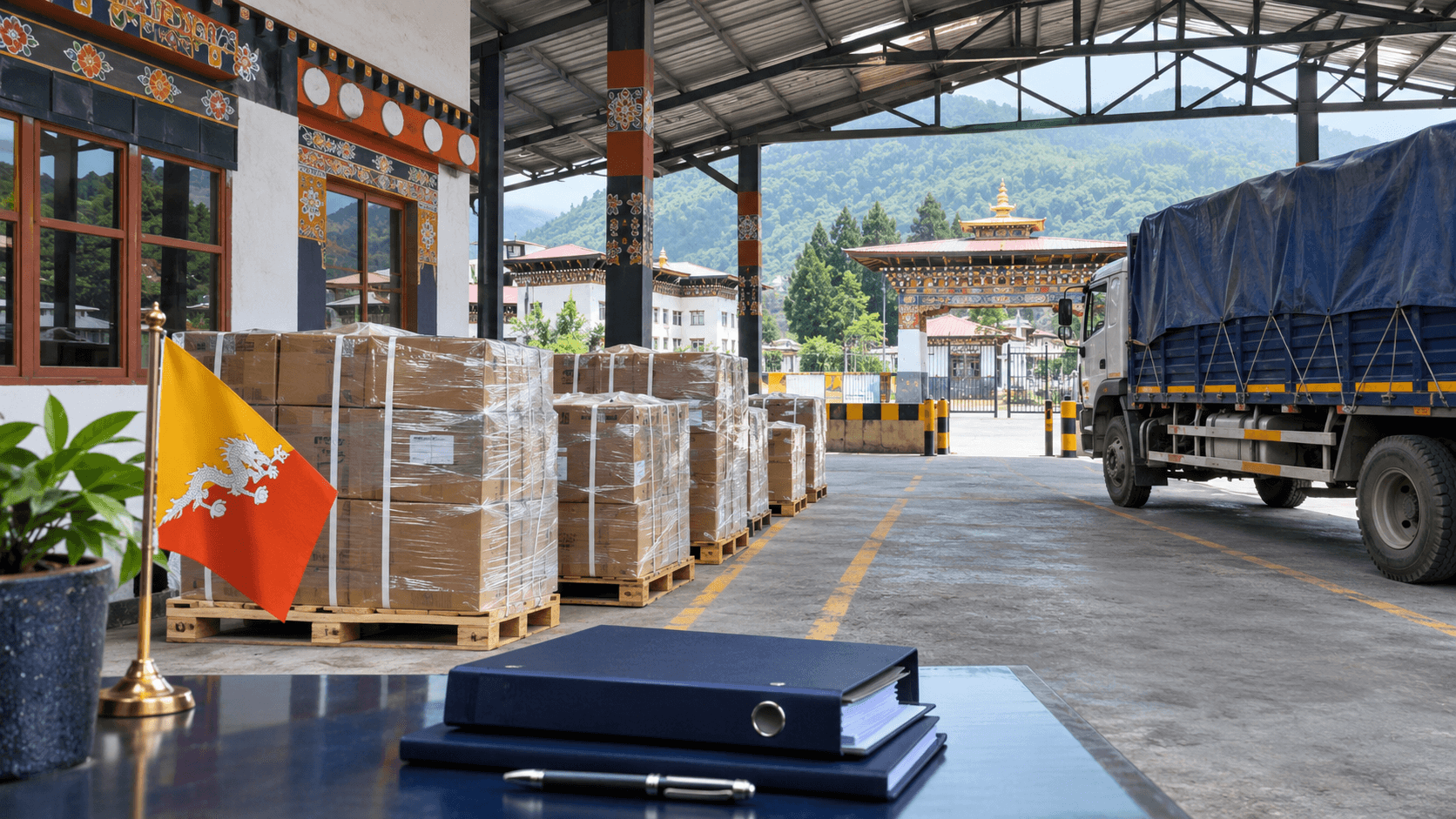
1. How Bhutan Customs Clearance Works
Bhutan customs clearance brings together the importer’s eligibility, commercial documents, product permissions and tax assessment. For machinery, electronics, garments, food or other business stock, settle those points before the supplier dispatches the goods.
The route also matters. Indian-origin goods, third-country goods arriving by air, and overseas cargo transiting an Indian port can require different supporting records. Goods purchased from an Indian seller do not automatically acquire Indian origin.
Bhutan’s Department of Revenue and Customs (DRC) publishes the Customs Rules and Regulations: Revised Edition 2023 alongside the GST Rules 2026 and Excise Rules and Regulations 2026. Use the current rules and notifications relevant to the shipment. DRC acts and rules.
A Practical Clearance Sequence
- Confirm the importer and transaction. Identify the Bhutan consignee, business activity, tax details and any registration or licence needed.
- Check product admissibility. Review the actual goods, origin, condition and intended use; obtain required approvals before shipping.
- Reconcile the documents. Match the invoice, packing list, transport record and permit details.
- Submit the declaration. The importer or appointed representative presents the entry and supporting records through the applicable customs process.
- Resolve assessment and examination. Respond to classification, valuation, origin or inspection queries.
- Pay and obtain release. Complete the assessed payments and release formalities before collection.
- Arrange delivery and retain records. Coordinate the receiver, unloading and proof of delivery, and keep the clearance file.
Appoint a person to own each outstanding action. A truck arriving at the border does not mean that the importer’s permissions, assessment or payment are complete.
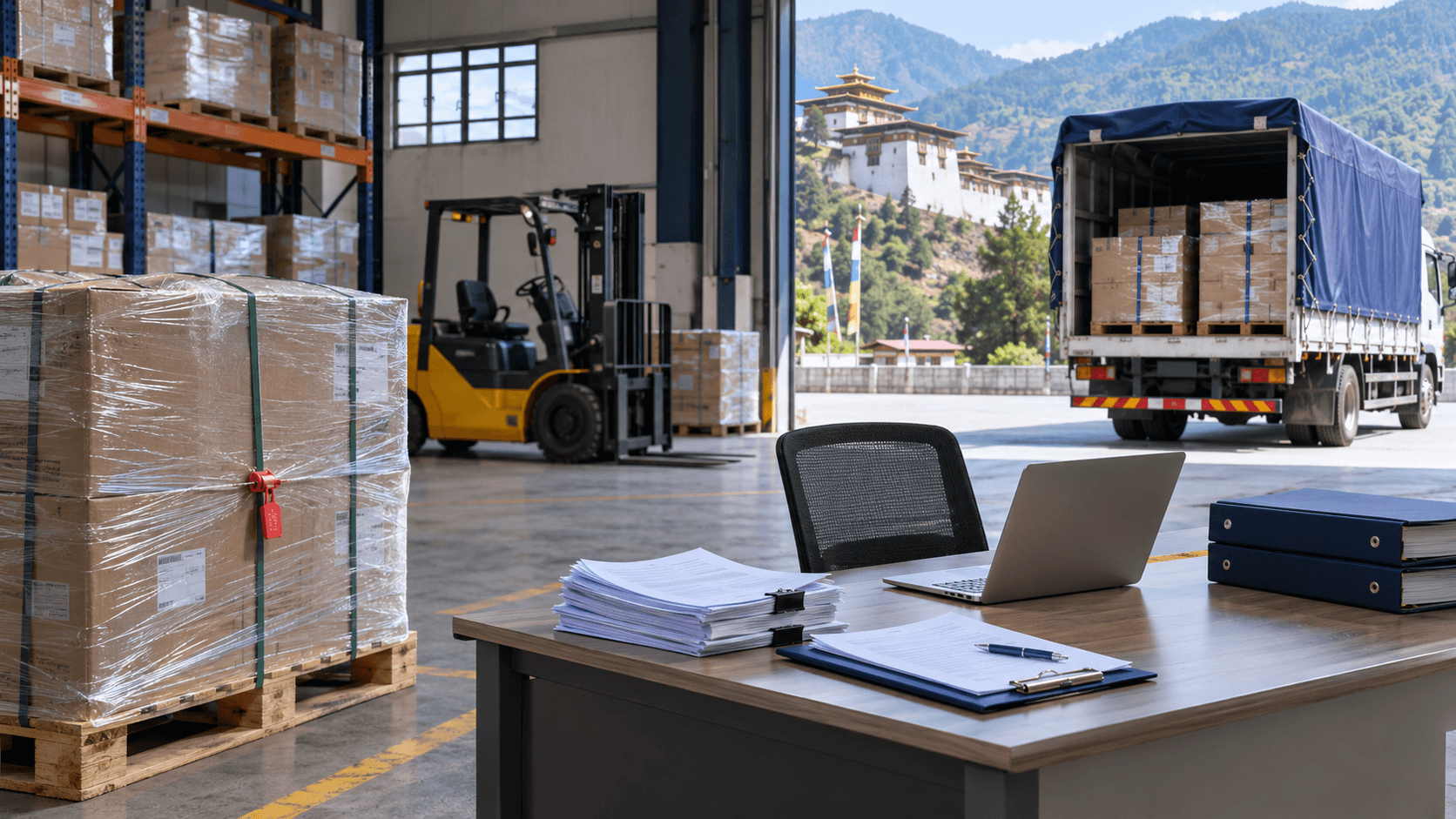
2. Documents Required for Bhutan Customs Clearance
Build a shipment-specific document checklist with the importer and customs representative. Rule 289 of the 2023 Customs Rules lists import-supporting records and marks several as applicable only in the relevant circumstances. Customs Rules, import documentation.
Core Commercial and Transport Records
- Commercial invoice: supplier and buyer, clear product descriptions, quantities, prices, currency and agreed delivery terms.
- Packing list: package count, contents and gross/net weights; add dimensions for handling and freight planning.
- Transport and freight records: the bill of lading, air waybill or road transport record appropriate to the journey, plus freight evidence where relevant.
- Insurance record: the marine, air or transit policy where applicable.
Supporting Approvals and Evidence
Depending on the transaction, the file may also need an import licence or permit, agent authorization, restricted-goods approval, origin evidence, exemption certificate or a guarantee associated with third-country transit through India. Customs can request further evidence and hard copies.
Ask separately about business-licence details, taxpayer information and any tax-clearance document required for a particular application. Treat the final checklist as specific to your importer and procedure.
Before sending the file, compare the model numbers, quantities, currency, consignee and shipment reference across every document. Explain separate invoicing for accessories, spare parts, samples or discounts. If the supplier repacks the goods, update the package schedule and transport instructions together.
For a diplomatic, project-exempt, temporary or secondhand shipment, request the applicable procedure and approval documents early. General commercial paperwork alone may not establish eligibility for special treatment. The freight-forwarding documents guide offers a useful preparation checklist; Bhutan-specific requirements still need confirmation.

3. Bhutan GST 2026: Rate, Import Value and Input Credits
Bhutan introduced GST on 1 January 2026, replacing the sales-tax regime. The DRC’s implementation notice applies GST to taxable supplies and imports destined for consumption in Bhutan. Official GST implementation notice.
The standard GST rate is 5 percent, subject to the applicable exemptions, zero-rating and other legal treatment. Import GST is payable at customs clearance. A customs-duty concession does not by itself establish a GST exemption. DRC GST business guide.
Use the Correct Import GST Base
Rule 272 of the GST Rules 2026 states that the import GST value includes customs value, excise tax, customs duty and other fees and charges at import. A worksheet using only purchase price, or only CIF plus duty, can therefore be incomplete. Have the representative identify the additions applicable to your entry. GST Rules 2026, Rule 272.
Use the assessed customs value and applicable charges once available. Avoid counting freight or insurance twice if they are already included in the invoice price or customs-value calculation.
Registration and Input Tax Credits
Import GST payment and business GST registration are separate questions. Check whether your business must register, whether voluntary registration is available and whether an input tax credit is allowed for the particular purchase. Retain the import entry and payment evidence needed to support a claim.
An expected input credit should remain separate from the cash required at clearance. Do not remove the import GST from the shipment’s funding plan merely because the business expects to recover it later. The DRC GST guidance explains registration, credits and filing.

4. Worked Import Tax and Landed-Cost Example
This example explains the arithmetic using hypothetical figures in Bhutanese ngultrum (BTN). It is not a machinery tariff quote or a tax assessment.
Assume a customs value of BTN 1,000,000, confirmed customs duty of BTN 0, no excise and no other charges included in the import GST base. If standard 5 percent GST applies:
- Customs value: BTN 1,000,000
- Customs duty: BTN 0
- Excise and other additions to the GST base: BTN 0, assumed for this example
- GST base: BTN 1,000,000
- Import GST: BTN 50,000
- Customs value plus the illustrated import taxes: BTN 1,050,000
The zero-duty assumption requires a valid basis, such as eligible treatment for qualifying Indian-origin goods. It does not apply automatically because a supplier ships from India. Confirm the actual product, origin evidence and relief before entering zero.
What If Duty or Excise Applies?
For a second arithmetic example, assume duty of BTN 100,000, no excise and no other GST-base additions. The GST base becomes BTN 1,100,000, and 5 percent GST is BTN 55,000. Duty plus GST totals BTN 155,000. The duty figure is an invented worksheet input, not a rate recommendation.
Add border handling, agent services, storage if incurred, onward trucking and unloading to complete the cost through your chosen delivery point. Record any applicable tax on those services and avoid duplicating amounts already included.
Keep confirmed assessments separate from allowances. Your final worksheet should show the currency, exchange-rate basis, delivery endpoint and exclusions so a customs estimate can be reconciled with the eventual invoices.
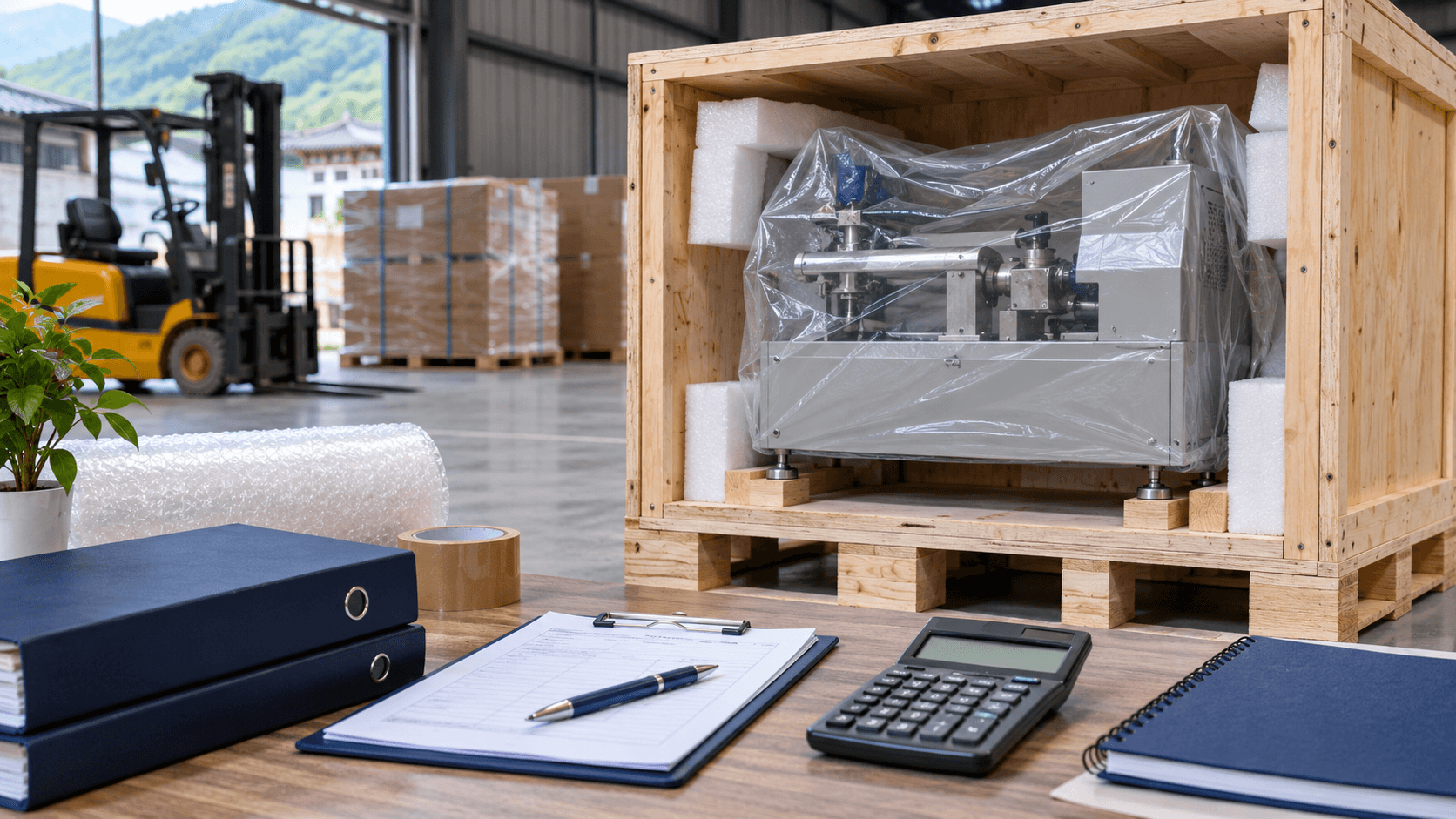
5. Bhutan HS Codes, Customs Duty and Origin
Start classification with the product’s material, function, composition and technical specifications. A supplier’s HS suggestion is a useful starting point, but the declaration needs the correct Bhutan tariff line.
International HS headings share a six-digit foundation; national tariff subdivisions can be more detailed. The eCMS portal lists the Bhutan Trade Classification and Tariff Schedule 2022, amended 2026. Use the full applicable code and current amendments when checking duty. Official Bhutan tariff schedule.
Why Product Details Change Classification
- For garments, identify fabric composition, knitted or woven construction and the type of garment.
- For equipment, provide the actual function, model and technical literature.
- For food preparations, provide the ingredients, processing and presentation.
- For a shipment of parts, show the identity and use of each item rather than grouping everything as general machinery.
Ask the representative to document the selected code, duty treatment and unresolved classification questions. Broad labels such as electronics or textiles do not establish a reliable duty rate.
Indian Origin and Third-Country Goods
The India–Bhutan trade arrangement establishes a free-trade regime. Confirm eligibility and supporting origin evidence for your goods, while checking any relevant restrictions. A Chinese-made product resold by an Indian trader remains a separate origin question. Embassy of India: trade relations.
For goods from Nepal, China, Singapore, Europe or another origin, check the tariff line and any applicable preference or exemption. Third-country origin does not mean that every product attracts the same rate, or that every entry necessarily has duty payable.
Keep customs value, duty, excise and GST as separate worksheet lines. The classification and relief review should happen before committing to a selling price or final landed-cost budget.
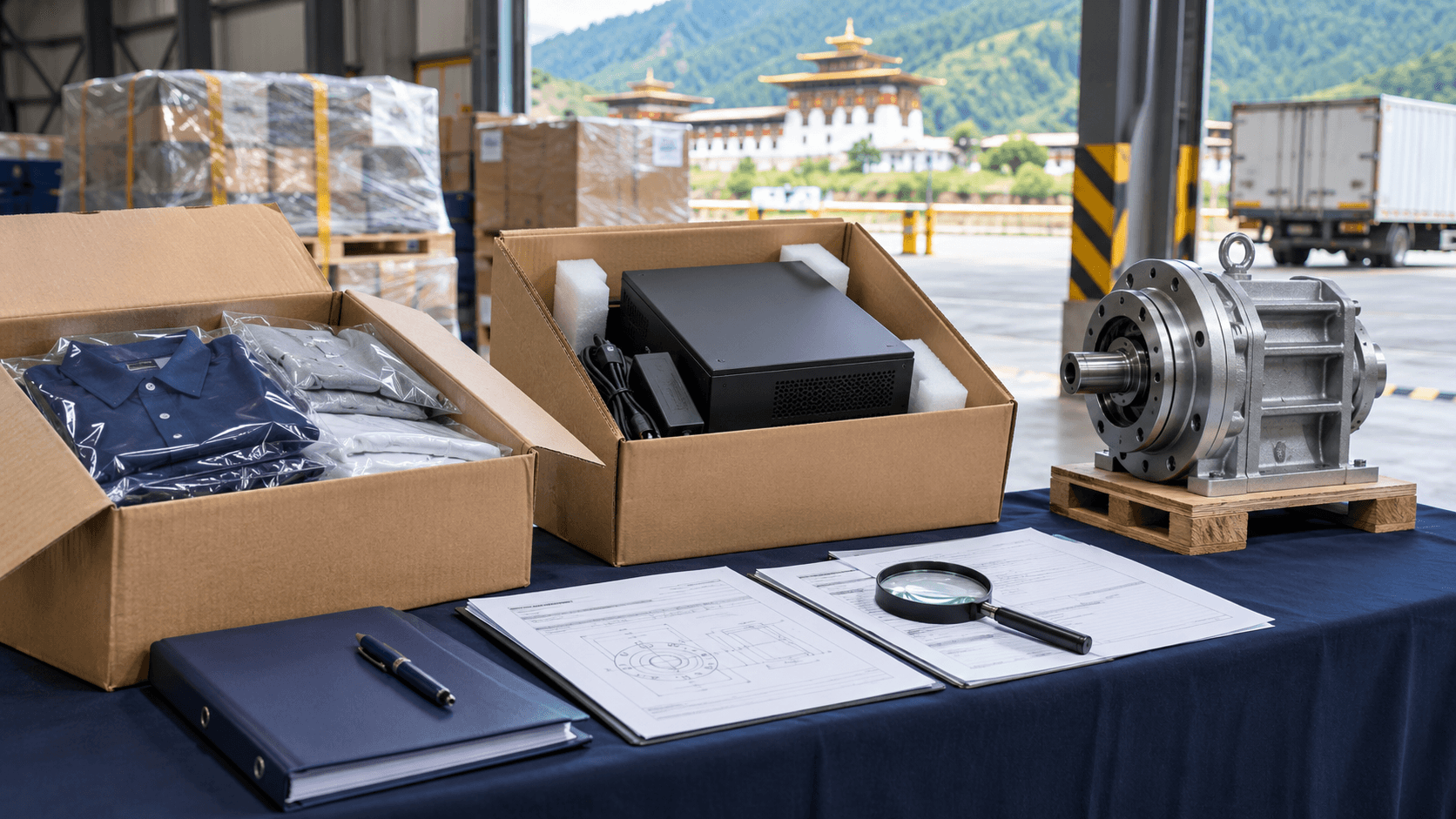
Review Your Bhutan Import Documents
Share the invoice, packing list, product specifications and delivery location for a customs-readiness review.
6. Bhutan Import Licences and Importer Readiness
Confirm the importing entity’s eligibility and required business permissions before booking freight. Requirements depend on the goods, importer, origin and transaction; a general statement that every shipment needs the same licence can be misleading.
For third-country industrial imports, the Department of Industry identifies the Department of Trade under MoICE as the import-licence issuer. Its guidance directs applications for relevant machinery, raw materials, spares and accessories through Bhutan TradeFin Net (BTFN), with industry recommendations where required. Official industrial import-licence guidance.
Prepare the Application Around the Actual Shipment
- Confirm the legal importer, business activity and authority to import the proposed goods.
- Ask which trade licence, industrial recommendation or product permission applies.
- Prepare the supplier invoice or pro forma, product specifications and other requested supporting records.
- Submit through the appropriate current channel and resolve queries.
- Check the approval against the final products, quantities, value, route and validity before dispatch.
The applicant should retain the issued approval and its conditions. If the order changes, ask whether an amendment or fresh approval is needed.
Goods supplied from India may follow different licensing arrangements from third-country imports. Product restrictions and sector approvals still need checking. Likewise, transit through India does not replace Bhutan’s import permissions.
Appointing a forwarder or customs representative does not transfer the importer’s responsibility for accurate commercial information. Agree who submits an application, who supplies evidence and who tracks approval. Request confirmation of any uncertain registration requirement instead of relying on an old generic checklist.

7. Restricted Goods, Product Permits and Special Cases
Check product controls before shipment, including goods that are used, donated, regulated or intended for a particular end use. Permission to transport an item and permission to import it are separate checks.
Food, Plants, Animals and Related Products
The Bhutan Food and Drug Authority (BFDA) publishes sanitary and phytosanitary import procedures. Depending on the goods, permits, exporting-country certificates, inspection or quarantine arrangements may be relevant. Use the product-specific procedure and confirm the approved entry arrangements. BFDA SPS import information.
Medicines and Medical Products
BFDA’s Medical Product Division regulates medical products. Its guidance states that imports for sale and distribution require registration and import authorization. Check the requirements for the actual medicine, device or supplement and the licensed parties involved. BFDA medical-product FAQs.
Communication and Radio Equipment
BICMA provides technical-clearance and ICT type-approval forms, along with specific applications for certain radio and satellite equipment. Review the model, frequency and intended use before purchase or dispatch. BICMA requirements and forms.
Used Goods, Chemicals and Excisable Products
For used machinery, chemicals, fertilizers and other controlled commodities, ask the representative to identify the relevant authority and current restrictions. Supply condition reports, technical specifications, safety data or other evidence requested for that product.
Alcohol and tobacco need a current product-specific excise and regulatory review. Older statements that tobacco sales are universally banned are outdated: Bhutan’s government announced legalization of import, sale and purchase following the 2021 amendment, subject to controls. Do not use historic passenger allowances as commercial-import tax guidance. Government tobacco amendment notice.
For exemptions, diplomatic imports or temporary entry, obtain the appropriate authorization and keep track of any end-use, disposal or re-export conditions. A free sample or donation still needs its own customs treatment.
8. Common Customs Delays and Mistakes to Avoid
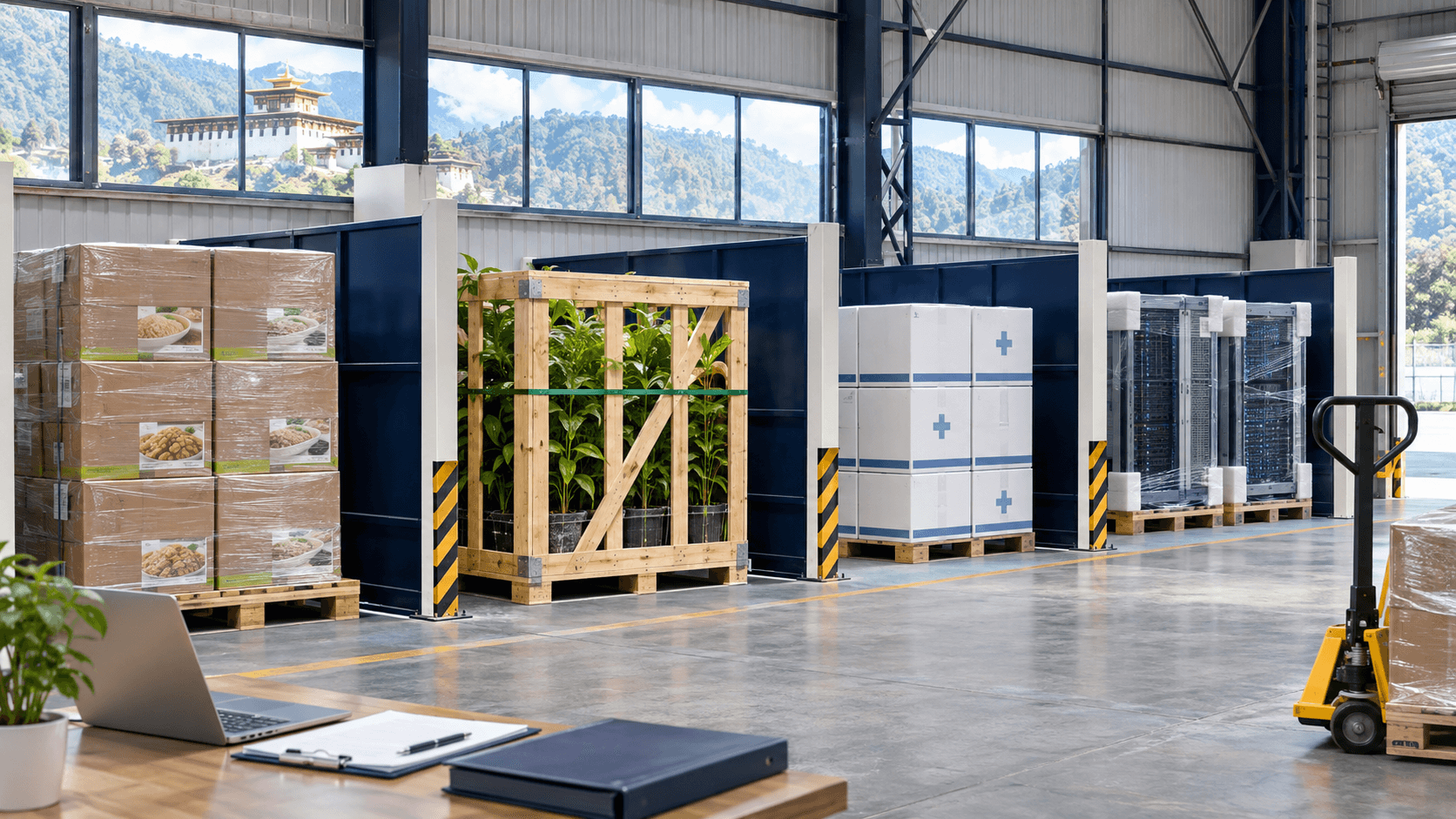
Avoidable delays often start before the cargo leaves the supplier. Review these points while corrections can still be made.
- Vague invoice descriptions: replace general goods or spare parts with identifiable products, models and materials.
- Inconsistent packing records: reconcile package count, quantities and weights after repacking.
- Unconfirmed importer permissions: settle the applicant, licence and approval conditions before loading.
- Unverified HS codes: check the full Bhutan tariff line with the representative.
- Origin assumptions: distinguish manufacturing origin from the supplier’s address or transit country.
- Incomplete tax budgeting: include GST-base additions and excise where applicable.
- Missing authorization: confirm who may submit and respond on the importer’s behalf.
- Late responses: name a contact who can supply specifications, evidence and payment instructions.
- Delivery arranged too early: coordinate collection with regulatory release and the receiver’s readiness.
If Customs Raises a Query
Ask for the exact information needed, the affected entry or product line and the person responsible for responding. Use a controlled set of corrected documents so the supplier, carrier and agent work from the same version.
Request a revised timing and cost assessment if examination, testing, storage or document correction changes the plan. Agree who approves any extra handling or holding charges.
Keep the Transit and Delivery File Connected
For cargo moving through an Indian port or overland transit route, confirm the transit records and discharge responsibilities as well as Bhutan entry. Record package condition and any authorized transfer. The India-to-Bhutan shipping guide and Nepal-to-Bhutan cargo guide explain the route-planning questions.
After delivery, retain the declaration, assessment, receipts, approvals, invoices and proof of delivery. Keep the file available for accounting, an eligible credit claim or a later customs review.
9. How Sea Sky Cargo Helps With Bhutan Customs Coordination
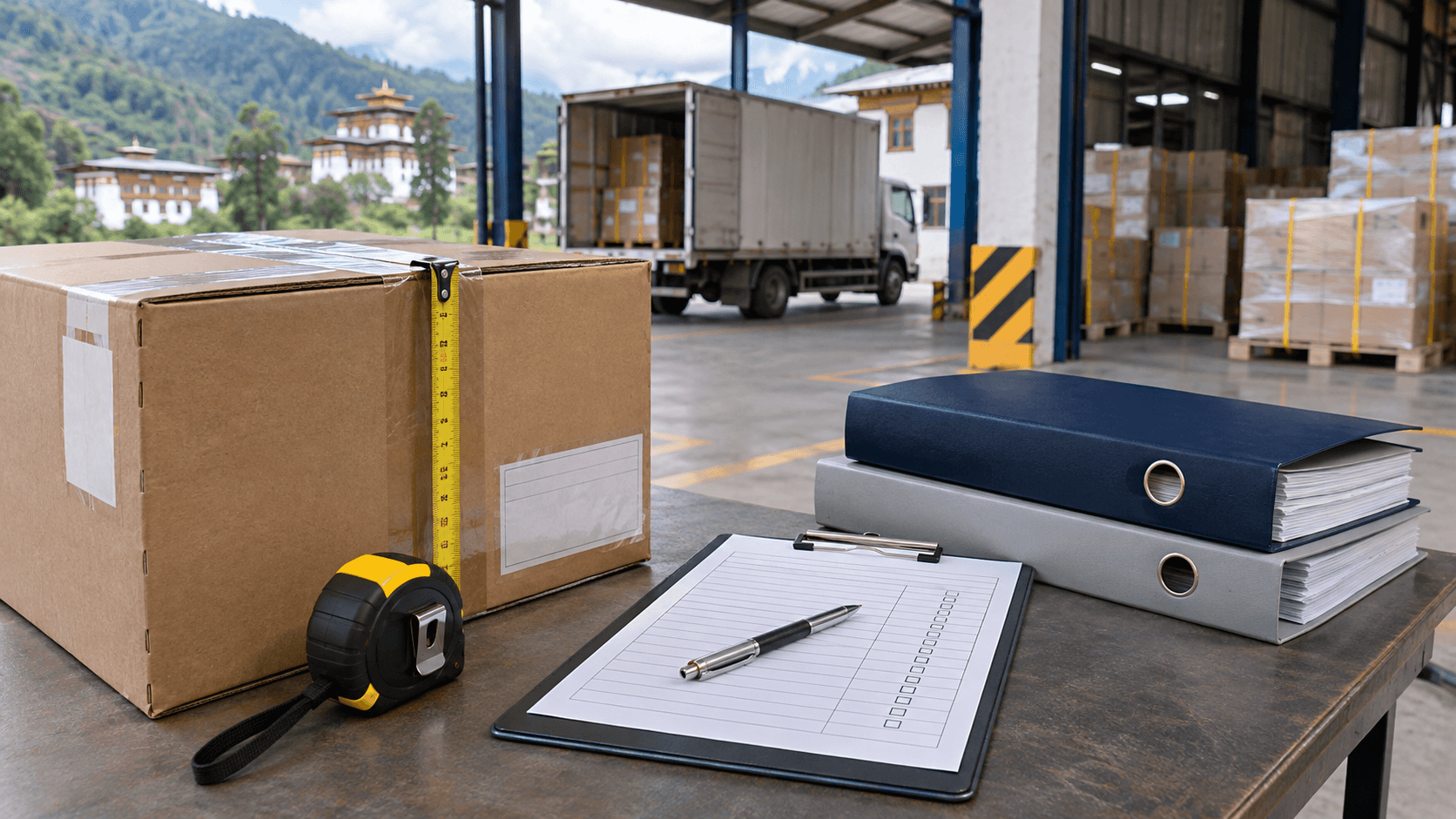
Sea Sky Cargo was established in 1988 and identifies Bhutan among the regional markets it supports. Its published services include forwarding, inland transport, consolidation and project-cargo support. About Sea Sky Cargo.
For a Bhutan-bound shipment, ask the team to define a service scope with the importer and relevant customs representatives. The proposal can then address the route, document handoff, border or airport arrangements and delivery requirements.
Support to Discuss Before Booking
- Document-readiness review: compare the invoice, packing list, cargo description and available approvals.
- Product-information coordination: collect specifications needed by the appointed representative for classification and permission checks.
- Tax-estimate preparation: identify the assumptions and questions that need confirmation before clearance.
- Customs and carrier handoffs: agree which party submits each record and responds to a query.
- Shipment updates: establish the milestones, contact and escalation process for your load.
- Onward delivery: review access, receiving hours, unloading and trucking to Phuentsholing, Thimphu, Paro or the agreed destination.
Confirm each task in the quotation, including services handled by partners. Licence decisions, classification acceptance, tax assessments and release remain with the relevant authorities; the importer supplies accurate facts and permissions.
For heavy, fragile or regulated cargo, share photographs and specifications early. A shipment-specific review can identify a missing permit, unsuitable vehicle or unloading constraint before dispatch.
Read the Bhutan freight-forwarder selection guide for questions to ask about responsibilities and quote scope. Explore regional cargo services and discuss how customs coordination fits your transport plan.
10. Prepare Your Bhutan Customs Clearance File
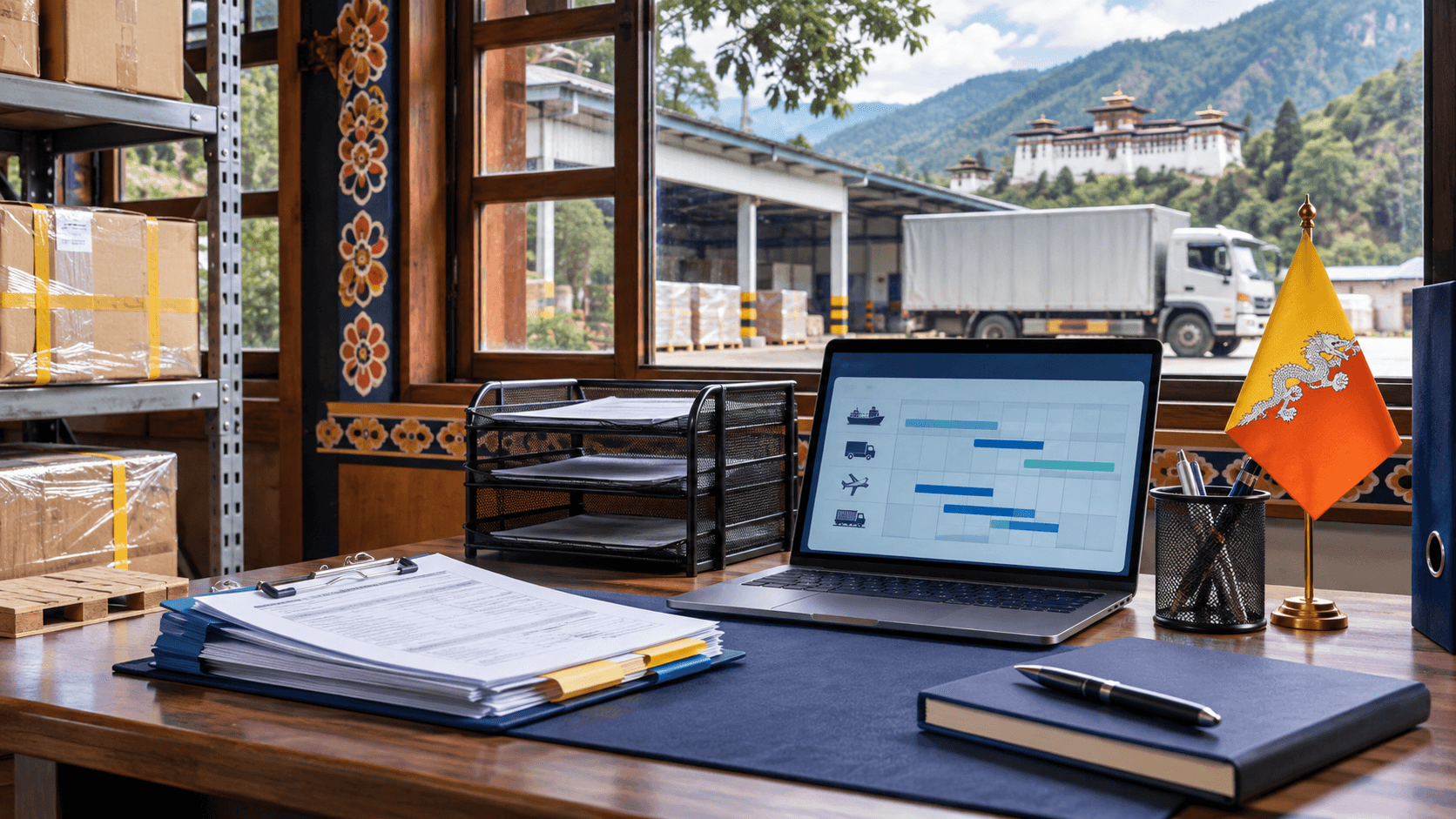
Start with the goods and the importer, then connect the permissions, documents, tax estimate and delivery plan. For a repeat order, recheck any changed model, origin, value, approval or tariff treatment rather than copying the previous entry unchanged.
Send Sea Sky Cargo a useful shipment brief:
- Pickup country, supplier city and planned route, if known.
- Product names, manufacturing origin, condition and intended use.
- Draft invoice, packing list and technical specifications.
- Package count, packed dimensions and gross weight.
- Bhutan importer details and the status of licences or product approvals.
- Cargo-ready date and delivery address, including access and unloading needs.
Ask for a written scope separating freight, customs-agent services, government taxes, handling and delivery. Show which costs are confirmed and which depend on classification, permits, examination or actual waiting time.
Need help clearing cargo into Bhutan? Sea Sky Cargo can review your documents, coordinate customs clearance and arrange delivery to your Bhutan warehouse. Request a Bhutan cargo review.
This guide focuses on commercial cargo preparation. Confirm the current treatment for the exact goods and entry before dispatch, particularly where an exemption, restriction or special procedure is involved.
Need Help Clearing Cargo Into Bhutan?
Sea Sky Cargo can review your documents, coordinate customs clearance and arrange delivery to your Bhutan warehouse.
Related posts

1970-01-01
Sea + Air Freight: How SeaSky Helps Businesses Ship Smarter

2026-11-15
Freight Forwarding Company for Bhutan Cargo: How to Choose the Right Partner
2026-11-14
India to Bhutan Shipping Guide: Road Freight, Customs and Border Documents
2026-11-11