
Why perishable cargo needs careful planning
Perishable cargo needs more care than regular shipments. Food, medicine, flowers, frozen goods, dairy products, fruits, vegetables and other temperature-sensitive items can lose quality quickly if the shipment is delayed, poorly packed, exposed to heat or moved through the wrong route.
A proper perishable cargo service in Nepal protects the cargo from pickup to delivery by matching the product with the right freight mode, packaging, temperature control, documents, customs preparation and final delivery timing.
Sea Sky Cargo supports perishable and temperature-sensitive cargo movement for Nepal-linked shipments. Whether goods move by air freight service in Nepal, road freight service in Nepal or a combined route, planning early helps reduce damage, delay and product loss.

What is perishable cargo?
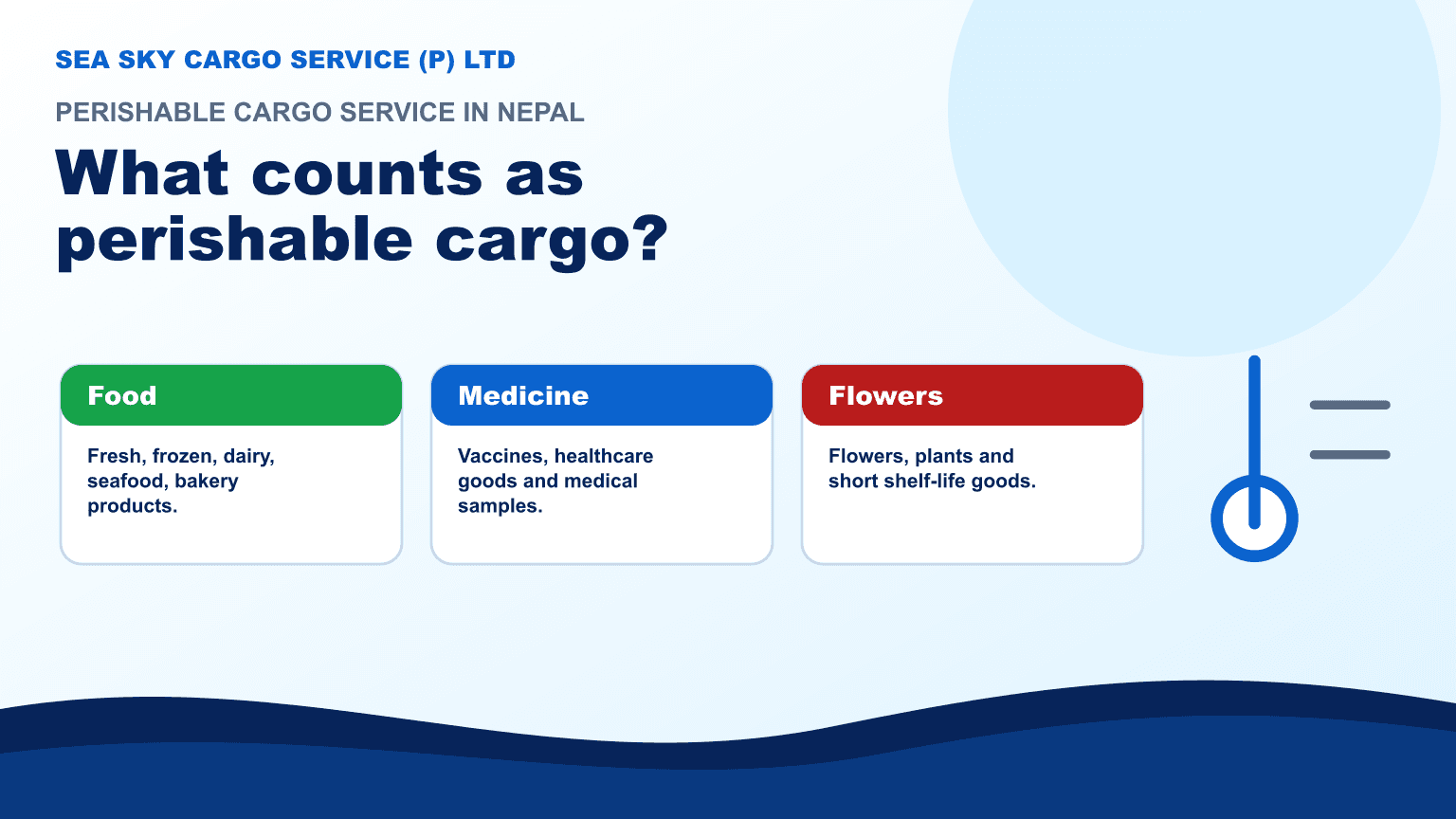
Perishable cargo includes goods that can spoil, expire, melt, lose freshness, lose quality or become unsafe if they are not handled properly during transport.
Common perishable cargo includes:
- Fresh fruits and vegetables
- Frozen food
- Meat and seafood
- Dairy products
- Bakery items
- Flowers and plants
- Medicine and vaccines
- Medical samples
- Health supplements
- Chocolates and confectionery
- Temperature-sensitive cosmetics
- Certain chemicals and laboratory goods
Some perishable goods need chilled transport. Some need frozen handling. Others only need protection from heat, humidity or long delays. The shipment plan should start with the exact product name, shelf life, temperature range and packaging method.
Why perishable cargo needs special handling
Perishable cargo can be damaged by time, temperature and handling mistakes. Even a short delay can affect product quality, buyer trust or medical usefulness.
Special handling helps protect:
- Freshness
- Shelf life
- Product safety
- Medical effectiveness
- Buyer trust
- Product value
- Compliance documents
- Delivery schedule
Frozen goods can become unsafe if they thaw. Medicine can lose effectiveness if exposed to heat. Flowers can wilt if delayed. Fresh food can spoil if packaging and route planning are poor.
The risk is not only the main transport leg. Pickup, warehouse waiting, airport handling, border movement, customs inspection and final delivery can all affect the cold chain.
Air freight for perishable cargo
Air freight is often the best option for urgent or high-value perishable cargo because it reduces transit time. For sensitive cargo, a faster route can be worth the higher freight cost when delay would cause product loss.
Air freight may be suitable for:
- Medicine
- Vaccines
- Medical samples
- Fresh flowers
- Premium food products
- Short shelf-life goods
- Urgent export shipments
- High-value perishables
The key planning points are temperature range, packaging duration, airline acceptance, airport cut-off time, customs readiness and delivery after arrival. If the shipment is also moving through a connecting flight, the transit point matters.
For more air cargo planning context, review Sea Sky Cargo's air freight service in Nepal.
Road freight for perishable cargo
Road freight is useful for regional movement and final delivery. It may be used for cargo moving inside Nepal, from nearby countries or from an airport or warehouse to the final destination.
Road freight may be suitable for:
- Food distribution
- Chilled products
- Frozen goods
- Medicine delivery
- Local warehouse delivery
- Border-to-door cargo
- Airport-to-door movement
For perishable goods, road freight planning should include vehicle type, delivery timing, route condition, loading process, waiting exposure and final handover. A good road plan also checks whether the delivery point is ready to receive the goods immediately.
For route planning and final delivery support, see Sea Sky Cargo's road freight service in Nepal.
Packaging for perishable goods
Packaging is one of the most important parts of perishable cargo shipping. The right packaging depends on the product, temperature requirement, handling route and transit time. Packaging may include: Insulated boxes Thermal cartons Ice packs Gel packs Dry ice where allowed Temperature indicators Data loggers Leak-proof inner packaging Strong outer cartons Proper labels Ventilated packaging for certain fresh goods Normal cartons may not be enough for sensitive goods. The packaging should protect the cargo during pickup, storage, airport handling, customs checks and final delivery.
| Cargo type | Packaging focus | Main risk |
|---|---|---|
| Fresh food | Ventilation, insulation and clean handling | Spoilage, bruising or moisture damage |
| Frozen goods | Frozen packing plan and short exposure windows | Thawing and product safety risk |
| Medicine | Validated temperature range and monitoring | Loss of product effectiveness |
| Flowers | Moisture, ventilation and fast routing | Wilting and quality loss |
Shipping food, medicine or temperature-sensitive cargo?
Share the product, temperature range, route, shelf life and documents. Sea Sky Cargo can review the plan before the shipment moves.
Documents needed for perishable cargo
Documents depend on product type and route, but perishable cargo usually needs clearer paperwork than general cargo. The product description should be specific and should match the invoice, packing list, certificates and labels.
Common documents may include:
- Commercial invoice
- Packing list
- Airway bill or transport document
- HS code
- Certificate of origin if required
- Health certificate if required
- Phytosanitary certificate for plant products if required
- Import permit or approval if needed
- Product specification sheet
- Temperature requirement details
- Batch number and expiry date for medicine
- Ingredient list for food products
- Insurance document if applicable
Avoid vague terms like "food items" or "medical goods" when the actual product can be described clearly. Clear descriptions help the freight team, airline, customs broker and consignee understand the handling requirement.
For official checks, use Nepal Customs at customs.gov.np, the Department of Drug Administration at dda.gov.np and the Department of Food Technology and Quality Control at dftqc.gov.np, depending on the product.
Customs clearance for perishable cargo in Nepal
Customs clearance in Nepal is critical for perishable shipments because delay can damage the cargo. Importers and exporters should prepare documents before the shipment arrives, not after the goods are already waiting.
Customs may check:
- Product description
- HS code
- Declared value
- Country of origin
- Permit or certificate requirement
- Expiry date
- Label details
- Health or safety documents
- Duty and VAT
- Inspection requirement
Food, medicine, plant products, animal products and health-related goods may need extra documents or approval depending on the product. Requirements can change, so the importer should confirm the current position before dispatch.
A good plan reviews the HS code, permit position, certificate requirement, expected inspection and final delivery timing together. Sea Sky's temperature-controlled cargo guide gives additional cold-chain planning context.
Common mistakes to avoid
Perishable cargo problems usually happen because planning starts too late. For sensitive goods, every hour can matter. Common mistakes include: Using weak packaging Not confirming the required temperature range Choosing a slow route for short shelf-life goods Missing health or product certificates Not checking import permits Poor labeling No backup plan for delay Documents not matching the product Not planning final delivery timing Waiting until cargo arrives to arrange customs clearance The route, packaging and customs plan should be ready before dispatch. A shipment that is already waiting at the airport, border or warehouse is harder to fix than a shipment that is reviewed before pickup.
| Mistake | Possible result | Better action |
|---|---|---|
| Temperature not confirmed | Cargo may be exposed to the wrong condition | Share the temperature range before booking |
| Documents prepared late | Customs delay and product loss risk | Review permits and certificates before dispatch |
| Weak packaging | Leakage, spoilage or rejection | Use packaging matched to transit time |
| Final delivery not planned | Cargo waits after arrival | Confirm receiving hours and handover |
Perishable cargo checklist before shipping
Before shipping perishable cargo, check:
- Exact product name
- Required temperature range
- Shelf life or expiry date
- Packaging method
- Cargo weight and dimensions
- Pickup and delivery timeline
- Air or road freight option
- HS code
- Required permits or certificates
- Customs clearance plan
- Final delivery address
- Temperature monitoring needs
- Insurance requirement
This checklist helps reduce risk and improves shipment reliability. It also gives the freight forwarder the details needed to choose the right route and identify document gaps.
For high-value food, medicine or frozen cargo, also confirm who is responsible for monitoring time exposure, receiving the cargo, unloading quickly and reporting any temperature concern at delivery.
How Sea Sky Cargo helps with perishable cargo
Sea Sky Cargo helps customers plan perishable and temperature-sensitive shipments with practical freight and customs support. The planning starts with the product, temperature range, shelf life, packaging, route and documents.
Sea Sky Cargo can support with:
- Perishable cargo service in Nepal
- Food cargo shipping support
- Medicine and healthcare cargo guidance
- Temperature-sensitive cargo planning
- Air freight coordination
- Road freight coordination
- Customs clearance support
- HS code guidance
- Document review
- Final delivery planning
- Import and export cargo coordination
For sensitive cargo, early planning is the best way to reduce delay and damage. Sea Sky Cargo can help review shipment details before dispatch so the route, documents and delivery plan fit the product.
Use the get a quote form with product details, temperature range, cargo size, pickup point, destination, urgency and document status.
Frequently asked questions
What is perishable cargo? Perishable cargo includes goods that can spoil, expire, melt or lose quality during transport, such as food, medicine, flowers, frozen goods and dairy products.
What is the best way to ship perishable cargo? Air freight is often best for urgent or short shelf-life goods. Road freight is useful for regional movement and final delivery.
What documents are needed for perishable cargo? Common documents include invoice, packing list, HS code, airway bill or transport document, certificates, permits and temperature requirement details.
Can medicine be shipped as perishable cargo? Yes. Some medicine and vaccines need temperature-controlled or time-sensitive shipping.
Can Sea Sky Cargo help with perishable cargo in Nepal? Yes. Sea Sky Cargo can help with perishable cargo planning, air freight, road freight, customs support and document review.
The safest perishable cargo plan combines suitable packaging, the right freight mode, accurate documents, customs preparation and final delivery coordination before dispatch.
Need to ship perishable cargo in Nepal?
Sea Sky Cargo can help plan food, medicine and temperature-sensitive shipments with the right route, documents, customs support and delivery timing.