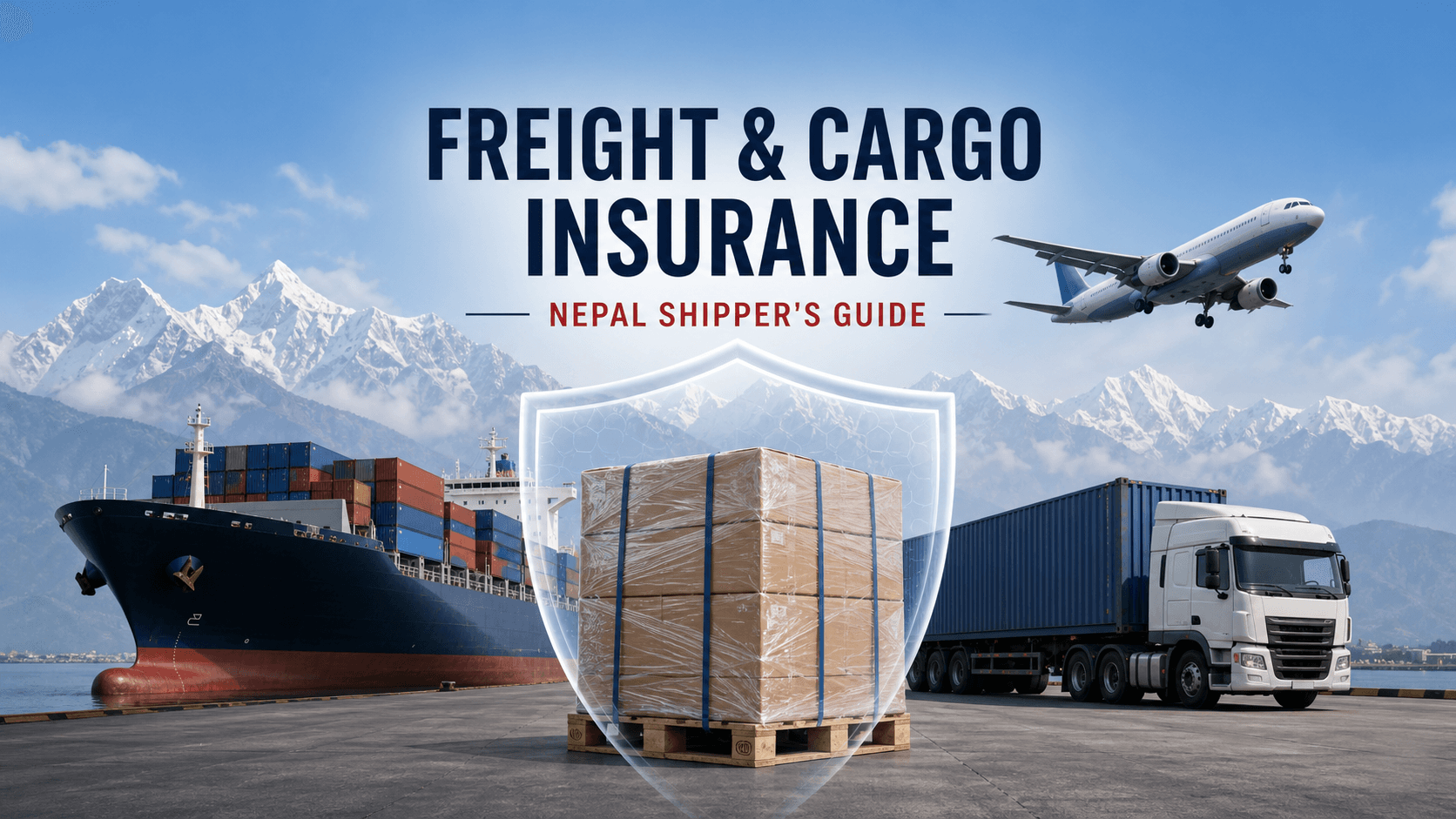
What is freight and cargo insurance?
Cargo insurance is a contract that can protect the financial interest in goods against specified physical loss or damage during transit. Depending on the wording, the insured journey may include collection, export handling, the international freight leg, transshipment, temporary storage, border movement and delivery. People often say freight insurance when they mean insurance for the cargo being transported. Strictly speaking, freight charges, cargo value, anticipated profit and related expenses are different interests. The policy schedule and valuation clause determine what has actually been insured. Insurance does not make a shipment risk-free. It transfers agreed financial risks to an insurer subject to coverage terms, exclusions, deductibles, limits, declarations and claim requirements. The policy wording, certificate and endorsements always control over a general summary. For Nepal-linked cargo, the route matters as much as the commodity. A shipment may move by air freight, ocean freight, road or a combination of all three, and every handoff must fit within the insured journey.
| Insurance question | What the shipper should confirm |
|---|---|
| Who is insured? | The buyer, seller, cargo owner or another party with an insurable interest |
| What is insured? | Exact commodity, quantity, packing and declared or agreed value |
| Where is it insured? | Origin, destination, transit countries, ports, airports and storage points |
| When does cover start and end? | The duration clause and any warehouse-to-warehouse conditions |
| Which risks apply? | Base cargo clauses plus any war, strikes, theft, temperature or special extensions |
| What remains uninsured? | Exclusions, deductible, sublimits and conditions that must be satisfied |

Cargo insurance is not the same as carrier liability
A shipping line, airline, trucker, warehouse or freight forwarder may have contractual or legal liability for cargo in its care. That does not mean the service provider automatically pays the full commercial value whenever goods are lost or damaged. Carrier liability usually depends on the transport contract, applicable convention or law, evidence of fault, package count, cargo weight, notice deadlines and available defenses. Compensation may be limited even when liability is established. A forwarder's own liability cover primarily protects the forwarder against covered legal liability; it is not a substitute for the cargo owner's policy. A shipper can preserve both routes. Notify the insurer promptly and also place the carrier or handler on notice so recovery rights are not lost. The insurer may later pursue a responsible third party through subrogation after paying a covered claim.
| Point | Carrier or forwarder liability | Cargo insurance |
|---|---|---|
| Whose interest is protected? | The service provider's liability exposure | The insured party's financial interest in the goods |
| What triggers recovery? | Liability must usually be established under the contract or law | A covered loss must occur during the insured period |
| How is payment measured? | May be limited by weight, package, event or contractual terms | Uses the insured value, loss calculation, limit and deductible |
| Can defenses apply? | Yes, including events outside the carrier's responsibility | Policy exclusions and conditions apply instead |
| Who handles the claim? | Claim is made against the responsible carrier or provider | Claim is notified to the insurer or appointed claims representative |

Institute Cargo Clauses A, B and C explained
Many international cargo policies use the Institute Cargo Clauses as a familiar coverage framework. Clauses A, B and C do not mean premium, standard and economy in a simple retail sense. They define different ways of describing insured perils, while all remain subject to exclusions, duration terms and policy conditions. The word all risks does not mean every cause of loss. It generally describes a broad method of cover, but exclusions and conditions still remove important causes. Delay, poor packing, inherent vice, ordinary leakage or wear, deliberate misconduct, and some war or strikes exposures can remain outside the base wording. The clause name alone is not enough. Ask for the complete wording, policy schedule and endorsements, then check the commodity, voyage, deductible, territorial limits, storage period, temperature conditions, theft restrictions and claim procedure.
| Coverage basis | General approach | Best used when |
|---|---|---|
| Institute Cargo Clauses (A) | Broadest of the three; often described as all-risks cover for accidental physical loss or damage unless excluded | The cargo needs wide protection and the policy accepts the commodity, packing and route |
| Institute Cargo Clauses (B) | Covers a wider list of specified events than Clauses C but remains named-perils cover | The shipper wants selected intermediate protection and the listed risks match the exposure |
| Institute Cargo Clauses (C) | Limited named-perils cover focused on major transport casualties | Minimum cover is acceptable for the commercial contract and cargo risk |

Covered risks, exclusions and special extensions
The correct question is not simply, 'Is the shipment insured?' It is, 'Is this cause of loss covered for this cargo on this route at this time?' The answer can change with the chosen clauses and endorsements. Perishables, pharmaceuticals, electronics, machinery, glass, artwork, used equipment and dangerous goods need specific disclosure. For temperature-sensitive cargo, combine the policy review with the operational controls in Sea Sky's perishable cargo service. For regulated materials, confirm both insurance acceptance and dangerous-goods handling before booking.
| Risk or loss | Typical insurance treatment | What to check |
|---|---|---|
| Fire, collision, overturning or major vessel casualty | Often included within standard cargo coverage, depending on the clause | Mode, conveyance and named-peril wording |
| Theft, pilferage or non-delivery | May require broad cover or a specific extension and security conditions | Unattended vehicle, high-value cargo and evidence requirements |
| Water entry, wet damage or rough handling | May be covered under broader clauses when accidental and not excluded | Packing suitability, container condition and survey evidence |
| Breakage, denting or scratching | Depends heavily on commodity, packing and policy wording | Fragile-goods conditions, deductibles and pre-shipment condition |
| Temperature excursion | Usually needs specific refrigerated or temperature-controlled cover | Temperature range, equipment breakdown, delay and data records |
| War, strikes, riots or civil commotion | Often handled through separate clauses or endorsements that can change or be cancelled | Current route, notice terms and geographic restrictions |
| Delay and loss of market | Commonly excluded from standard cargo cover | Whether a specialist extension or trade disruption product is required |
| Poor packing or inherent vice | Common exclusion where loss results from unsuitable packing or the goods' natural behavior | Packing standard, moisture control and commodity characteristics |

Insurance for air, sea, road and multimodal freight
Cargo insurance can follow goods across several modes, but the insured route must be described correctly. A policy written only for port-to-port ocean transit may not protect inland collection, transshipment storage or delivery to a Nepal warehouse. Warehouse-to-warehouse wording is useful, but it does not mean unlimited cover at every warehouse. Cover normally begins and ends according to detailed transit conditions, and extended storage or a change of destination can require notice and insurer agreement. Map the physical route before requesting insurance. Sea Sky's road freight service can help identify border, transshipment and final-delivery handoffs that need to appear in the insurance request.
| Freight mode | Important exposure | Coverage question |
|---|---|---|
| Air freight | Airport handling, impact, theft, missed connection and temperature sensitivity | Does cover include collection, airport storage, transfers and final delivery? |
| Sea freight | Water damage, container handling, vessel casualty, general average and long transit | Are port handling, transshipment, deck carriage and general average included? |
| Road freight | Collision, overturning, theft, weather exposure and border waiting | Are the countries, vehicle type, stops, security and delivery point accepted? |
| Rail freight | Impact, wagon handling, terminal transfer and route interruption | Does the declared route include rail terminals and connected trucking? |
| Multimodal freight | Coverage gaps at handoffs between carriers, terminals and warehouses | Is the full origin-to-destination journey insured under one continuous duration? |
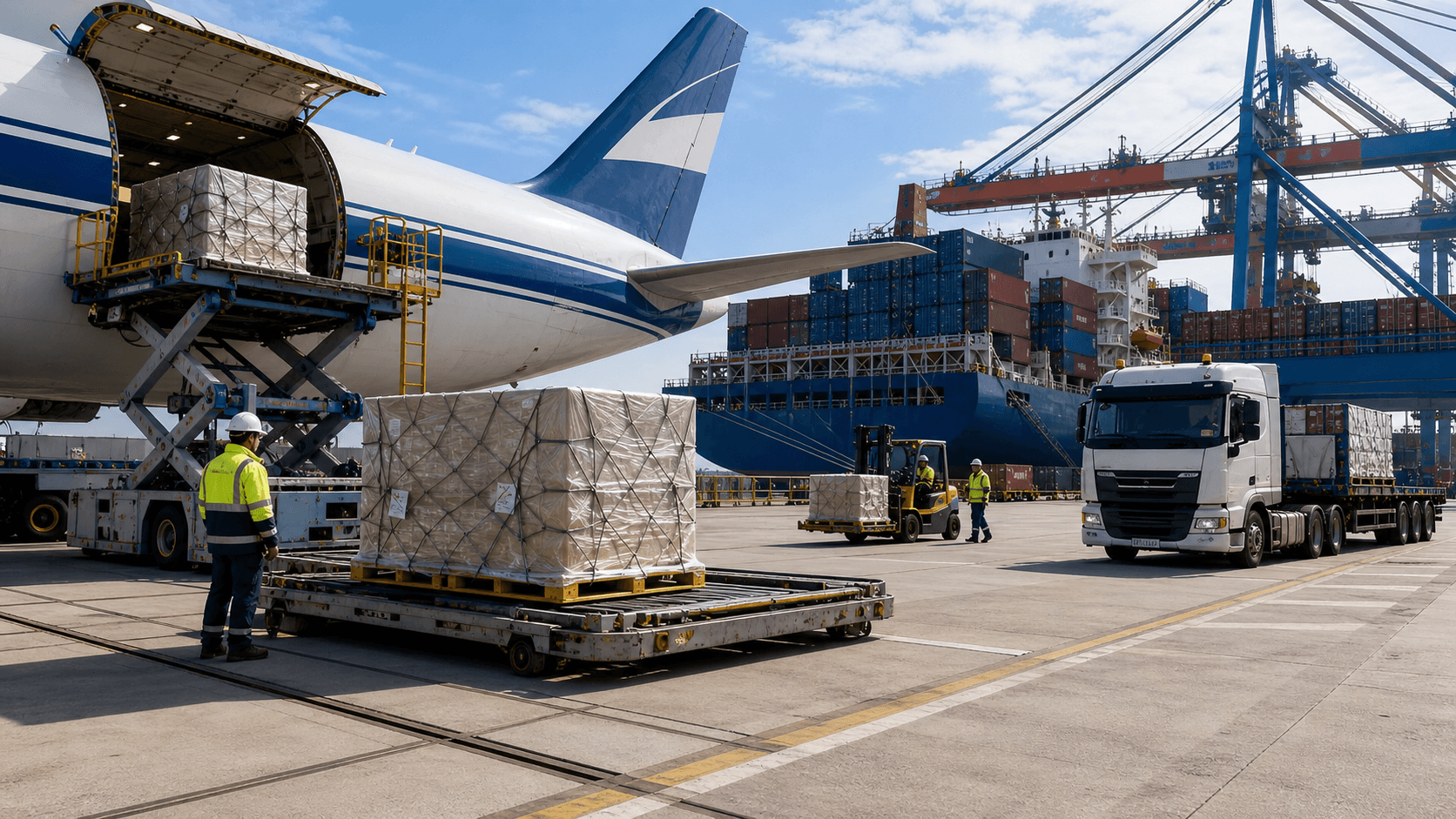
Need insurance planning for a Nepal shipment?
Share the commodity, value, packing, origin, destination, freight mode, Incoterm and cargo-ready date. Sea Sky can review the transport chain and help identify the coverage questions to resolve before dispatch.
Incoterms, CIF and CIP: who arranges insurance?
Incoterms define delivery responsibilities, costs and the point where risk transfers between seller and buyer. They do not replace the sales contract, and they do not guarantee that the party carrying the risk has adequate insurance. Under Incoterms 2020, CIF and CIP are the two rules that expressly require the seller to arrange cargo insurance for the buyer's benefit. They use different default coverage levels and different transport contexts. Cost responsibility and risk transfer can occur at different points. A seller may pay freight to a distant destination while risk has already transferred to the buyer earlier in the journey. Write the named place or port precisely, identify the Incoterms version, and align the insurance start and end points with the sales contract. Where a letter of credit is used, the bank may require a particular insurance document, amount, currency, date and coverage description. Check those documentary requirements before shipment.
| Trade term | Insurance position under Incoterms 2020 | Practical warning |
|---|---|---|
| CIF | Seller arranges insurance with the default minimum aligned to Institute Cargo Clauses (C) or similar; used for sea or inland-waterway trade | Minimum cover may be too narrow for manufactured, fragile or high-value cargo |
| CIP | Seller arranges broader default cover aligned to Institute Cargo Clauses (A) or similar; available for any mode or multimodal transport | Exclusions, deductible, route and local inland requirements still need review |
| FCA, FOB, CFR or CPT | The rules do not require the seller to arrange insurance | The party at risk should arrange cover from the correct transfer point |
| EXW or D rules | Insurance is not automatically mandated by the rule itself | The party carrying risk should decide how and where to insure it |

The Nepal inland-transit insurance gap
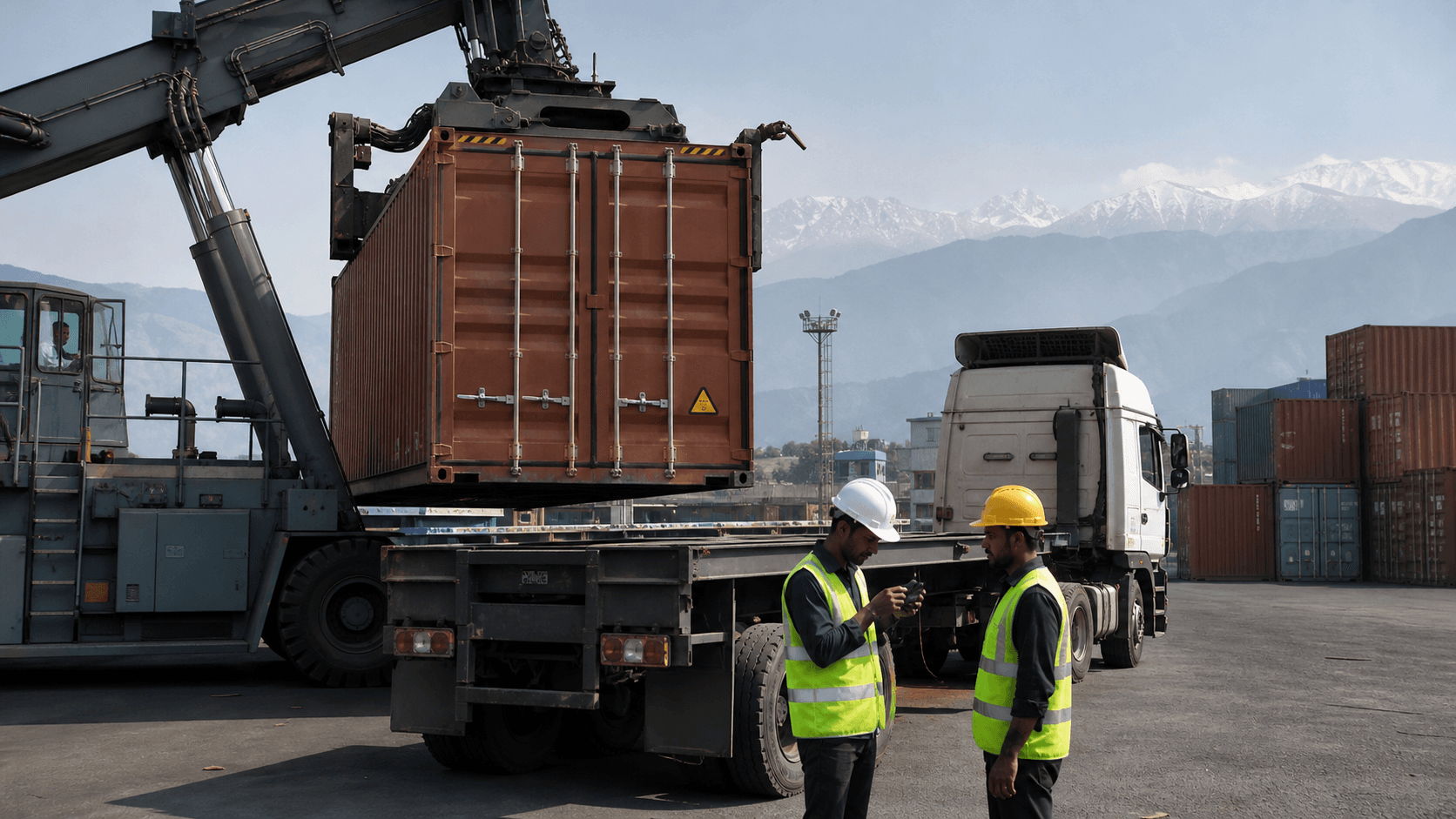
Nepal's landlocked route creates a coverage question that should be resolved before dispatch. Sea cargo may be insured to an Indian or Bangladeshi port, but the goods can still have a substantial transit through a port terminal, inland transport, a border point and Nepal delivery. An ICC review of national considerations published in 2025 notes that foreign transport insurance for Nepal can apply under CIF or CIP up to the point of entry, while subsequent transport inside Nepal requires separate attention. It also notes the practical need for inland transit cover where ocean protection ends at a foreign port. Current Nepal law, insurer licensing and policy acceptance should be confirmed for the exact transaction. Do not rely on a certificate that only says 'to Nepal' without checking the detailed route and termination clause. Sea Sky's port-to-door cargo guide shows the operational handoffs that the insurance review should follow.
| Journey segment | Possible gap | Confirmation to obtain |
|---|---|---|
| Supplier to origin port or airport | Seller's policy may begin only after handover to the main carrier | Exact attachment point and collection coverage |
| International freight | Policy may end at discharge port rather than final Nepal destination | Named destination, transshipment and duration wording |
| Indian or Bangladeshi port handling | Storage, customs hold or terminal movement may exceed the allowed period | Storage limits, extensions and notice requirements |
| Inland transit toward Nepal | Foreign ocean cover may not protect the complete road or rail leg | Separate transit policy, territorial scope and approved transporter |
| Nepal border to warehouse | Domestic movement may need locally arranged cover | Local policy, final destination and unloading coverage |
How insured value and premium are calculated
The insured value should reflect the agreed financial interest, not a casual estimate made after a loss. Depending on the contract and policy, the basis may include invoice value, freight, insurance cost, duties or other expenses, plus an agreed margin for anticipated profit. A documentary credit can impose its own minimum insurance amount. Over-insuring does not guarantee a profit, and under-insuring can reduce recovery. The insurer may apply an agreed-value clause, average or coinsurance condition, depreciation, salvage, deductible and policy limit. Used machinery and second-hand goods may need a valuation or condition survey. To request terms, prepare the commodity description, HS code, invoice value, packing method, package count, dimensions, weight, origin, destination, route, modes, Incoterm, shipping date and loss history. High-value or unusual cargo may also need photographs, a packing specification and survey report.
| Premium factor | Why it matters |
|---|---|
| Commodity | Fragility, theft attraction, shelf life, hazard and susceptibility to moisture or temperature |
| Insured value | Sets the insurer's financial exposure and may trigger survey or security requirements |
| Packing | Export packing, palletization, blocking, bracing and moisture protection reduce loss probability |
| Route and mode | Distance, transshipment, border crossings, ports and final delivery change exposure |
| Conveyance and storage | Vessel, aircraft, truck, warehouse quality and security influence acceptance |
| Coverage and deductible | Broader clauses, special extensions and lower deductibles generally cost more |
| Claims history | Past loss frequency and severity can affect terms, premium and risk controls |
| Single shipment or open cover | Regular shippers may use an annual or declaration-based arrangement instead of separate policies |

What to do when cargo is lost or damaged
A strong claim begins at delivery. Do not sign a clean receipt when damage, shortage or tampering is visible. Record a specific reservation on the delivery document, take photographs before unpacking, and notify the insurer or claims contact immediately. Typical documents include the insurance certificate or policy, commercial invoice, packing list, bill of lading or air waybill, delivery receipt, survey report, photographs, repair or replacement estimates, correspondence and a formal claim statement. The insurer can ask for more depending on the loss. Notification and legal time limits vary. Report the event at once even when the full amount is not yet known. Delay can weaken evidence and jeopardize rights against the carrier or insurer.
| Claim step | Action |
|---|---|
| 1. Protect people and cargo | Make the area safe and take reasonable steps to prevent further loss without destroying evidence |
| 2. Record delivery condition | Note damage or shortage on the receipt, photograph seals, packaging, container and goods |
| 3. Notify immediately | Contact the insurer, broker or appointed claims agent and inform the carrier or handler |
| 4. Request a survey | Allow the appointed surveyor to inspect before repair, disposal or repacking where practicable |
| 5. Preserve evidence | Keep damaged goods, packing, seals, temperature records and correspondence |
| 6. Quantify the loss | Separate sound and damaged cargo and obtain repair, salvage or replacement evidence |
| 7. Submit the claim file | Provide the policy, invoice, packing list, transport document, claim bill, survey and notices |
| 8. Preserve recovery rights | Meet carrier-notice deadlines and do not waive rights without insurer approval |

Common mistakes and how Sea Sky Cargo can help
Insurance works best when it is designed with the freight plan, not added as an afterthought. The most expensive gaps often come from an incomplete route description, assumed carrier protection or a policy certificate that nobody reviewed against the actual cargo.
- Buying insurance after the cargo has already started moving
- Assuming the freight forwarder's liability cover protects the full invoice value
- Accepting 'all risks' without reading exclusions and endorsements
- Using an ocean-only destination when the cargo must continue inland to Nepal
- Failing to disclose used condition, fragile goods, batteries, temperature needs or dangerous cargo
- Understating value, weight, route, packing or transshipment points
- Ignoring war, strikes, theft, storage and temperature extensions
- Signing a clean delivery receipt despite visible damage or shortage
- Discarding damaged packing before the insurer or surveyor inspects it
- Missing policy and carrier notification deadlines
Sea Sky Cargo can help map the physical route, assemble shipment data, explain where carrier responsibilities change, coordinate packing and freight documents, and communicate the insurance request to the appropriate provider. Insurance is issued and claims are decided by the relevant licensed insurer under its policy terms; Sea Sky's role is to help the transport and documentation side line up with that process.
For complex equipment, combine the insurance review with project cargo planning. For vehicles, review the complete RoRo cargo guide. Commercial shippers can also use the B2B logistics guide to plan customs and delivery responsibilities.
Share the commodity, value, Incoterm, origin, destination, freight mode, packing and delivery point through the get a quote form. Sea Sky can help turn those details into a clearer freight and insurance checklist before dispatch.

Protect the complete freight journey
Sea Sky Cargo can help coordinate the freight route, shipment documents, packing information and insurance request so the ocean, air, road and Nepal delivery stages are reviewed together.
Related posts
1970-01-01
Sea + Air Freight: How SeaSky Helps Businesses Ship Smarter

2026-09-28
E-commerce Logistics Nepal: Cross-Border Shipping from China, India, and the Gulf

2026-09-27
Monsoon Logistics in Nepal: How to Plan Shipments Around Floods and Landslides
2026-09-25