Sea Sky Cargo vs. South Asia Freight Forwarders
How does Sea Sky Cargo compare to other South Asia freight forwarders? If you're shipping into Nepal, Bhutan, or anywhere across this complex region, that question has real consequences. Choosing the wrong freight forwarder doesn't just cost money, it costs time, compliance standing, and sometimes an entire project timeline. South Asia is one of the most logistically demanding regions in the world: landlocked countries, multi-gateway routing, strict customs regimes, and terrain that consistently exposes the limits of operators who treat it like any other corridor. Common failure points include inland permit delays, seasonal road closures, and oversize-escort requirements that catch unprepared forwarders off guard.
This article puts Sea Sky Cargo Service Pvt. Ltd. under the microscope. Founded in 1988 and headquartered in Lalitpur, Nepal, Sea Sky brings nearly four decades of continuous South Asia operations to every shipment. You'll see how it stacks up against other regional freight forwarders across five criteria: credentials, coverage, pricing, specialized services, and reliability. By the end, you'll have a clear framework for deciding whether Sea Sky Cargo is the right partner for your shipment, or whether a different provider fits your situation better.
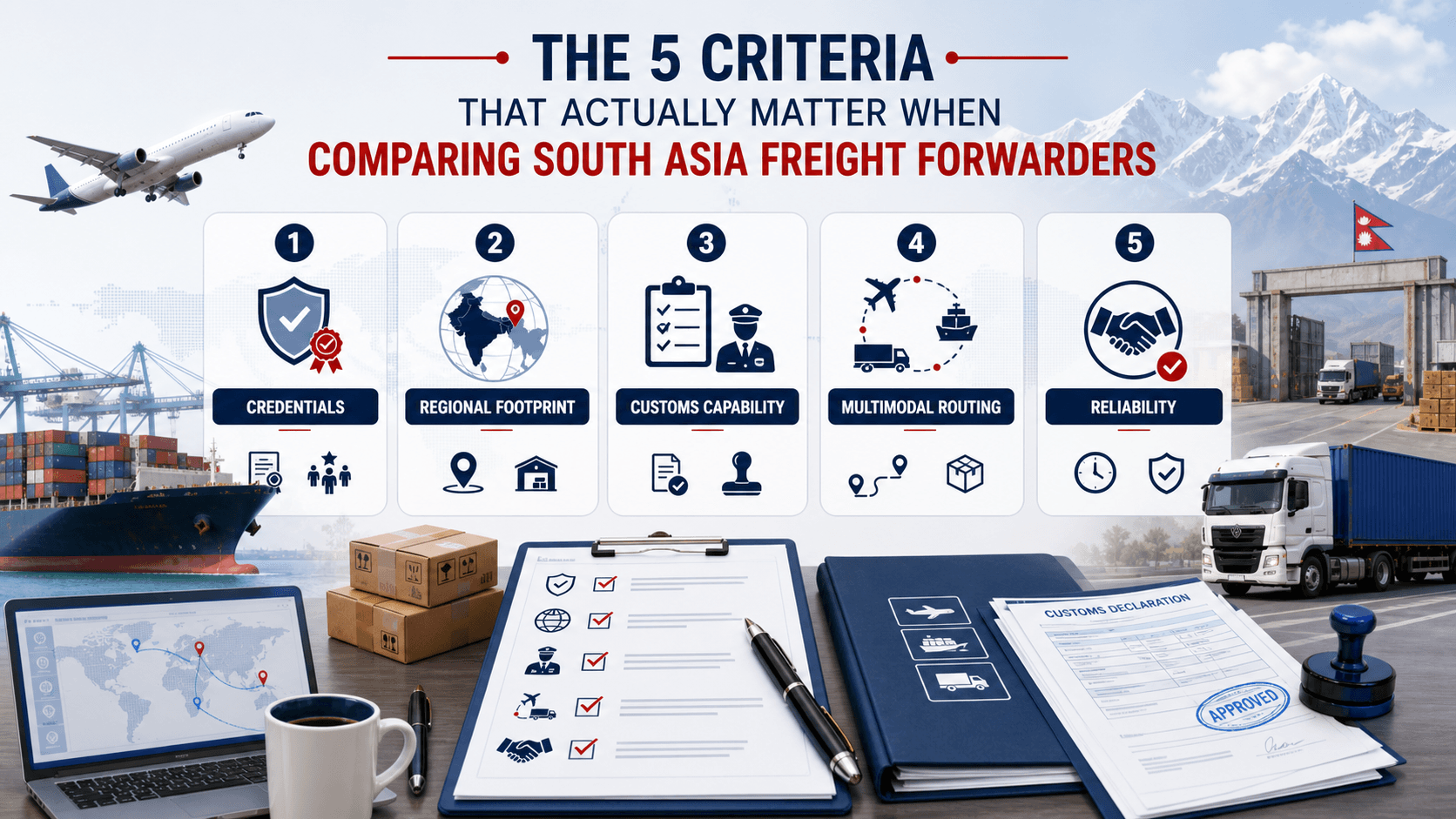
The five criteria that actually matter when comparing South Asia freight forwarders
Most shippers default to price when comparing forwarders. That's understandable, but in South Asia, especially for shipments into Nepal, Bhutan, or Afghanistan, price is rarely the differentiator that breaks a deal. What separates a capable regional forwarder from a costly mistake is a specific set of operational and regulatory qualifications.
The baseline credentials aren't optional. IATA accreditation authorizes a forwarder to handle air cargo and dangerous goods, ensuring your shipments aren't rejected at origin. FIATA membership signals adherence to international best practices in customs compliance and multimodal transport. ISO certification demonstrates structured, consistent operations that reduce the risk of documentation errors and port delays. A licensed customs broker designation adds legal standing for cross-border clearance that unlicensed operators simply can't provide. These aren't marketing badges; they're operational prerequisites.
Beyond credentials, regional specialization outweighs global brand recognition for South Asia lanes. A forwarder with a well-known global name but thin South Asia infrastructure often relies on local agents anyway. That outsourced arrangement creates a handoff risk: no single point of accountability, no direct relationship with customs officials, and no institutional knowledge of seasonal or geopolitical disruptions specific to the corridor.
The landlocked factor is the criterion most comparison guides ignore entirely. Shipping into Nepal, Bhutan, or Afghanistan means no direct seaport access. Every ocean shipment requires Indian gateway transshipment, cross-border documentation across multiple jurisdictions, and inland routing through terrain that standard carriers don't plan for. This is the primary filter before any other comparison begins.
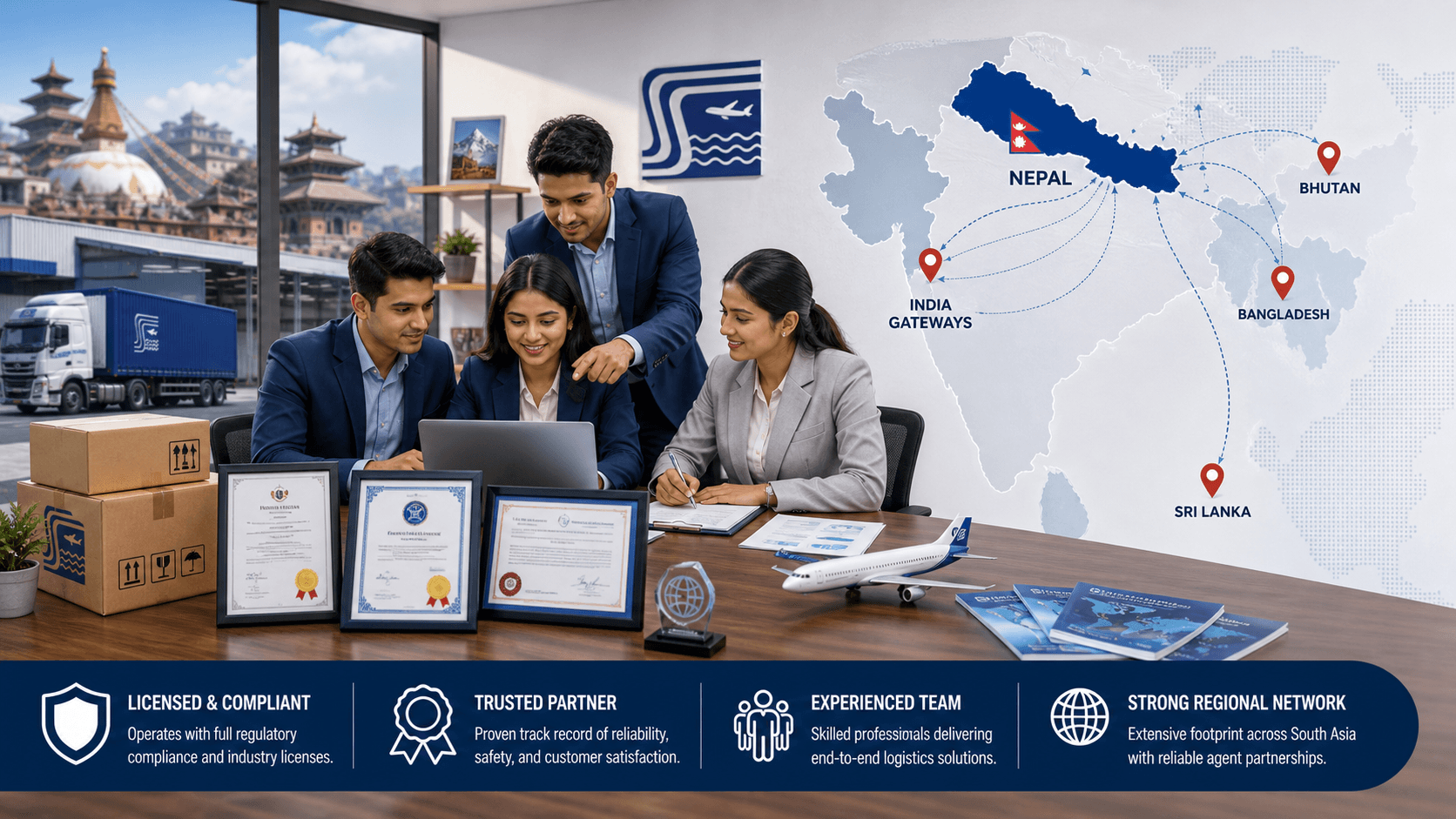
Sea Sky Cargo's credentials and regional footprint
Sea Sky Cargo was founded in 1988 and spent the following decades building something most newer entrants don't have: direct infrastructure inside the South Asia corridor, not just agent relationships. The company operates nine global locations and nine warehouses, with a presence spanning Nepal, Bhutan, India, Bangladesh, Pakistan, Sri Lanka, Maldives, and Afghanistan.
The credential stack is substantive. Sea Sky holds IATA certification, FIATA membership, ISO certification, a Custom Broker License, and NEFFA (Nepal Freight Forwarders Association) membership, with trade licenses active since 1997. The 1997 date refers to the company's trade license registration, distinct from the 1988 founding. Compare that baseline to a generic international freight broker or a newer regional entrant, which typically holds one or two of these designations at most. That regulatory continuity signals a level of standing that newer operators simply can't claim.
What does nearly four decades of continuous operation actually mean for a shipper? It means established carrier relationships, direct familiarity with customs officials across multiple border crossings, and documented experience handling complex cargo types across dozens of seasonal and geopolitical shifts. According to company-reported figures, Sea Sky has handled over 6,900 shipments for more than 500 clients, including government agencies, UN bodies, and multinationals. Those numbers reflect the kind of institutional knowledge that only accumulates through sustained, hands-on work in one of the world's most demanding logistics environments.
Global operators like DB Schenker, Kuehne + Nagel, and DHL Global Forwarding maintain solid footholds on the India and Bangladesh corridors, but they typically outsource the Nepal leg to local agents. Sea Sky's multi-country South Asia presence means that when your cargo crosses from Kolkata into Birgunj and onward to Kathmandu, the same team managing the ocean booking is also managing the inland clearance. That end-to-end control is the structural advantage no marketing budget can replicate.
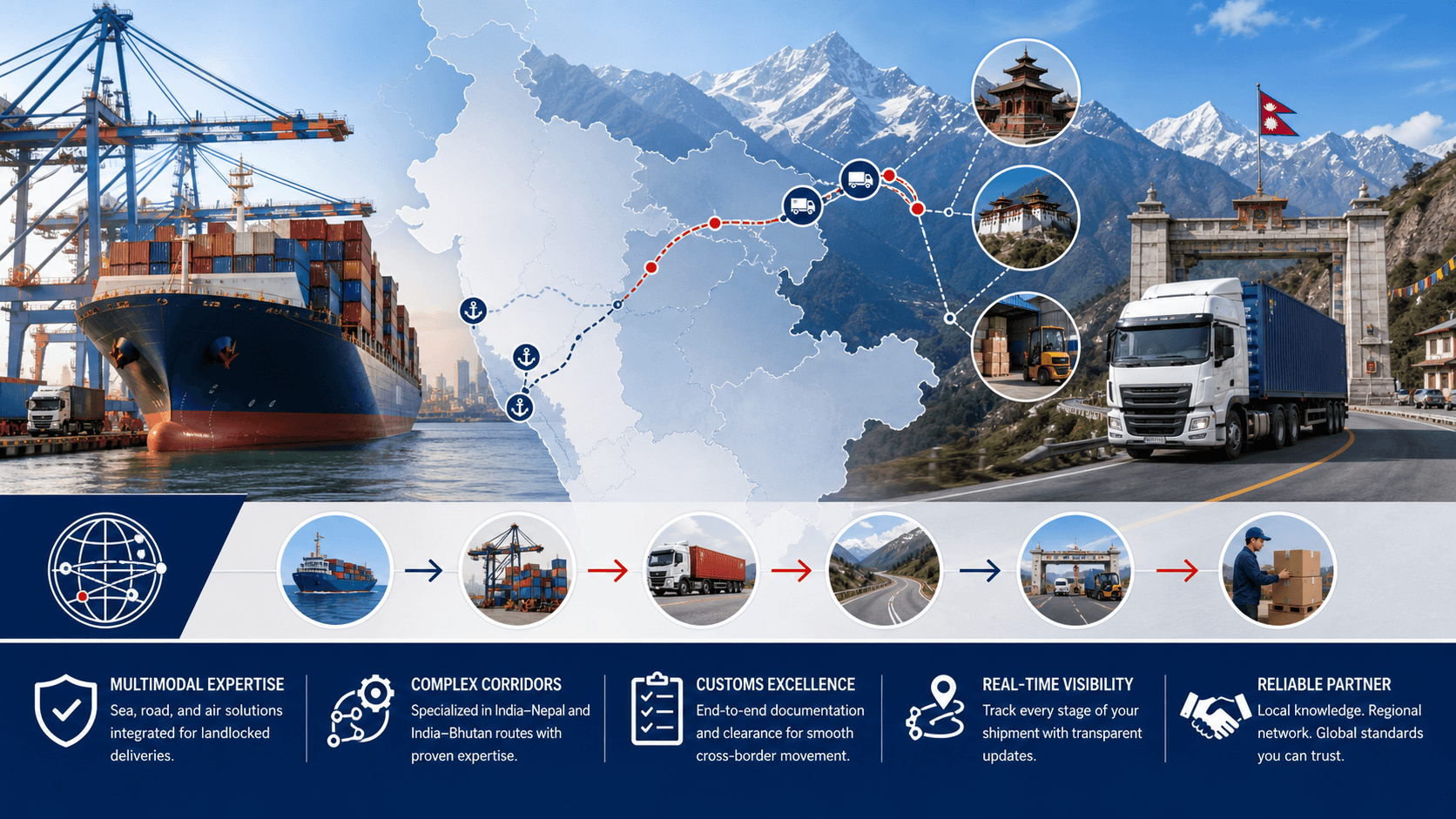
Coverage and routing: how Sea Sky Cargo handles South Asia's most complex corridors
Getting cargo into landlocked Nepal or Bhutan requires more than booking a container. It requires navigating Indian transit rights, gateway port selection, cross-border customs coordination, and last-mile delivery through terrain that most international forwarders hand off to unknown local agents.
Sea Sky's primary Indian gateways are Kolkata, Haldia, Vizag, and Mundra, with transshipment options via Singapore, Port Klang, Colombo, and Salalah depending on the origin lane. The Kathmandu-Birgunj-port inland leg is managed in-house, not subcontracted. This matters because inland legs are a frequent source of documentation errors: incorrect HS codes, missing transit bonds, or clearance gaps at the Indian border crossing that trigger delays and demurrage charges.
Many regional forwarders who perform well on India or Bangladesh lanes have no direct infrastructure in Nepal. When they accept a Nepal shipment, they hand it off at the Indian port, which creates a break in the chain of custody and accountability. A single documentation gap between the ocean forwarder and the local agent can hold cargo for days. Sea Sky's ability to manage the full corridor under one roof eliminates that gap.
The 2026 routing environment adds another layer of complexity. Red Sea and Strait of Hormuz pressure has pushed more vessels onto the Cape of Good Hope routing, adding 10 to 20 days to Asia-Europe and Middle East-US journeys. Sea Sky navigates these scenarios by analyzing non-Gulf transshipment alternatives and communicating realistic lead times upfront, so project timelines aren't blindsided by a routing change the shipper didn't anticipate. That kind of proactive communication separates experienced operators from reactive ones.
Compare Forwarders With Confidence
Need help choosing the right freight partner for Nepal, Bhutan, or wider South Asia? Sea Sky can review your route, cargo type, and documentation needs.
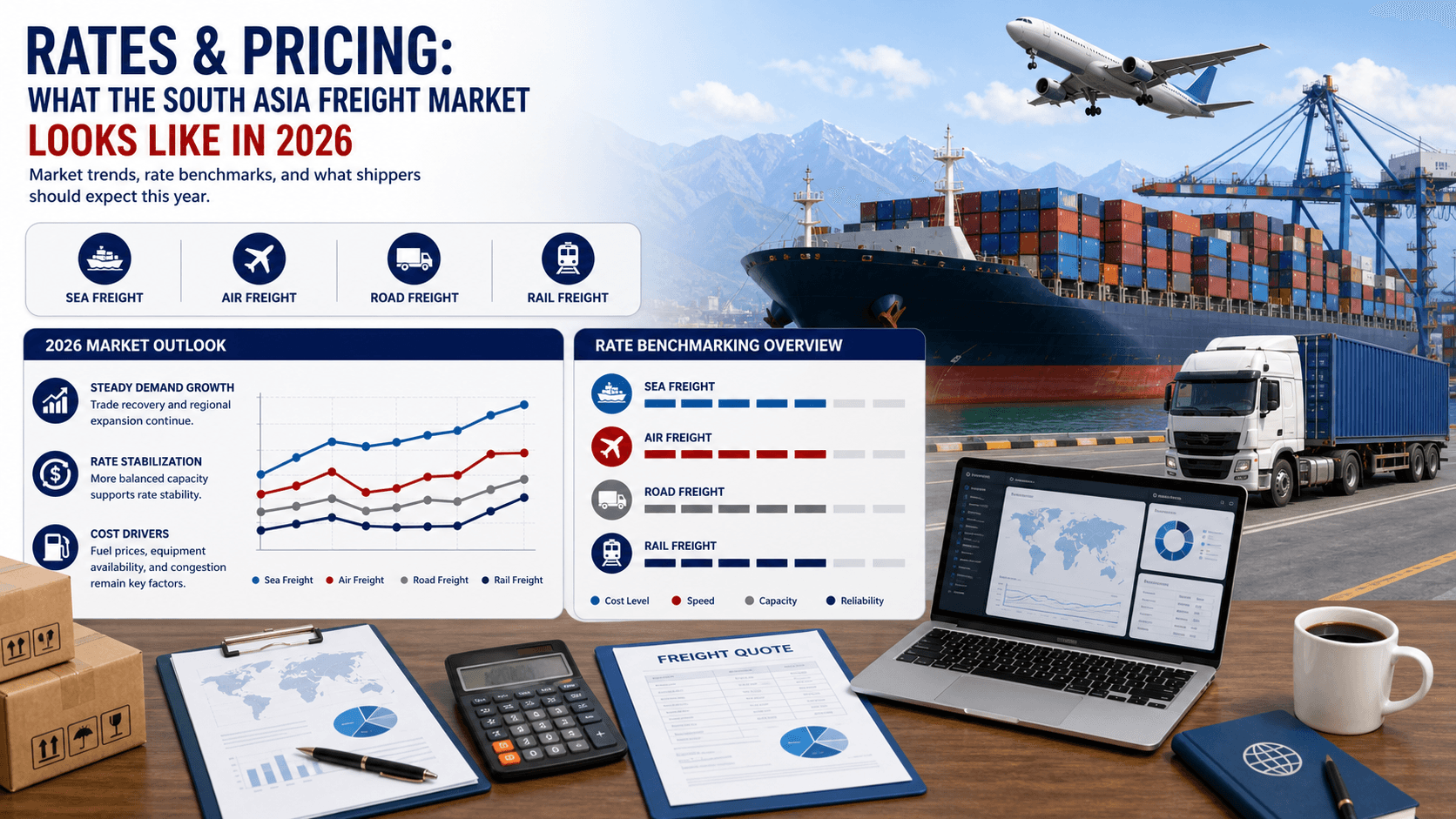
Rates and pricing: what the South Asia freight market looks like in 2026
Benchmark rates for key freight modes
Sea Sky Cargo doesn't publish a public rate sheet, and neither do most serious project-cargo forwarders. Rates are quoted based on cargo type, routing, seasonality, and current carrier availability. That said, shippers need a realistic benchmark before requesting a quote.
For the South Asia corridor in 2026, FCL rates on a 40-foot container run from $2,200 to $5,500 depending on origin and destination. LCL rates typically fall between $40 and $200 per cubic meter. Standard air freight runs $4.50 to $6.00 per kilogram, with express options reaching $7.00 to $12.00 per kilogram. These are base rates. Surcharges stack on top: peak season fees, bunker adjustment factor (BAF), currency adjustment factor (CAF), and emergency fees tied to current routing disruptions. Every forwarder operating in this market works within this same rate structure.
Why rate-shopping alone falls short on South Asia corridors
Rate-shopping alone fails on complex South Asia corridors. A $200 saving on a base rate evaporates instantly through a single customs delay triggered by a misclassified HS code. It disappears through a documentation gap at the Indian border crossing that holds a container for three days in demurrage. The true cost of choosing an inexpensive but inexperienced forwarder for landlocked South Asia routes isn't the base rate difference. It's the cascading cost of delays, penalties, and rework that follow when the operator doesn't know the corridor well enough to prevent them.
Specialized services that set Sea Sky Cargo apart from other South Asia freight forwarders
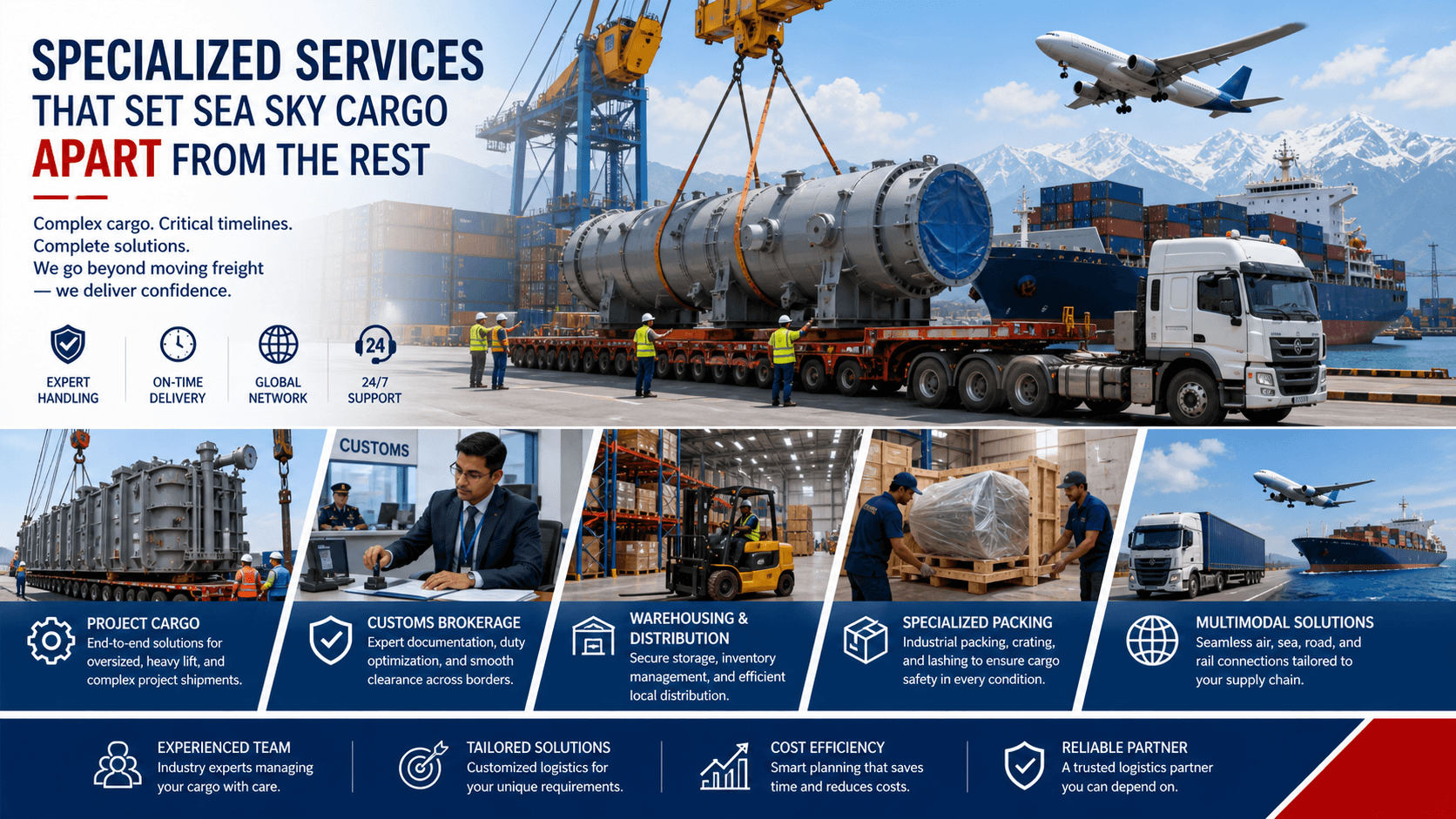
Standard freight forwarders can handle a standard FCL shipment on a well-traveled lane. Project cargo, dangerous goods, perishables, IOR services, and humanitarian logistics require a different class of operator, and this is where a Sea Sky Cargo comparison becomes most decisive.
Project cargo isn't just booking a flatbed. It involves multi-leg routing, specialized handling equipment, transit permit coordination across Indian transit zones, and timeline management that accounts for seasonal road restrictions and border crossing schedules. Relatively few forwarders in the South Asia region manage the full project cargo lifecycle without subcontracting the high-risk legs to operators they don't directly supervise.
The compliance-heavy categories are equally demanding. Sea Sky handles dangerous goods (DG) and cold-chain perishable shipments, both of which require specific carrier certifications and documentation chains that unaccredited operators can't maintain. IOR (Importer of Record) services are also available, allowing international businesses to ship into South Asian markets without a local legal entity and using Sea Sky as the legally responsible importer. For international companies without a local presence in Nepal, this is a meaningful capability that many regional operators do not provide.
Sea Sky has also reported serving UN bodies, bilateral aid programs, and international NGOs across South Asia's most challenging environments. Humanitarian logistics demand a forwarder with government relationships, proven customs clearance speed, and a track record in landlocked terrain where a delayed medical shipment carries real consequences. A low quote from an inexperienced operator isn't a savings. It's a liability.
When to choose Sea Sky Cargo, and when to consider alternatives
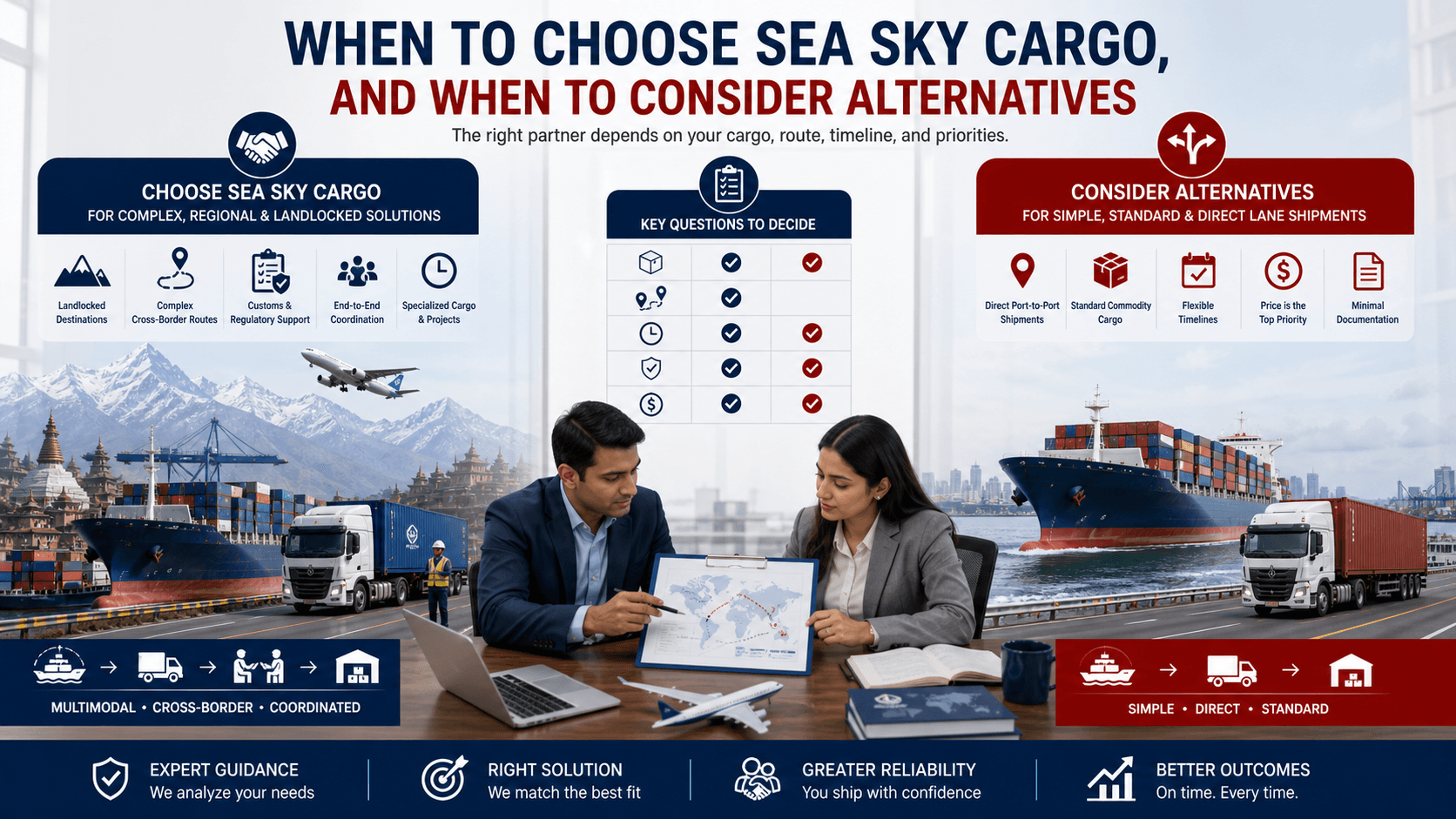
No forwarder is the right choice for every shipment. An honest comparison includes knowing where Sea Sky Cargo is the clear answer and where a different provider might serve you better.
Sea Sky is well-positioned for specific, high-complexity scenarios:
- Shipments into Nepal, Bhutan, or Afghanistan requiring full inland corridor management
- Project cargo and OOG freight with multi-leg routing and permit coordination
- Dangerous or perishable goods requiring compliance-grade handling and documentation
- IOR requirements for companies entering South Asian markets without a local legal entity
- NGO or government logistics where customs expertise and direct accountability are non-negotiable
In any situation where the landlocked factor, specialized cargo type, or multi-border documentation complexity enters the picture, Sea Sky's regional infrastructure becomes the decisive advantage over generalist competitors.
The honest alternative is worth acknowledging: if you're shipping standard FCL cargo to a major Indian port like Mumbai or Chennai with no landlocked extension, a larger global carrier with direct India coverage and a robust digital booking interface might offer faster self-service options. Sea Sky's strength is depth and complexity, not high-volume commodity shipping on straightforward lanes. Knowing that distinction makes the selection process more efficient for everyone.
When you're ready to request a quote, the conversation itself is diagnostic. Prepare your origin, destination, cargo type, HS code, dimensions, special handling requirements, and target timeline. Experienced forwarders ask the right questions before quoting, and the quality of those questions tells you a great deal about the operator's actual familiarity with your corridor. Request a quote from Sea Sky Cargo, ask your questions directly, and let their 38 years of answers make the decision straightforward.
How does Sea Sky Cargo compare to other South Asia freight forwarders? The answer is clear.
So, how does Sea Sky Cargo compare to other South Asia freight forwarders? On the criteria that actually drive outcomes, regulatory standing, regional infrastructure, specialized cargo capabilities, and proven reliability across complex corridors, Sea Sky Cargo Service Pvt. Ltd. holds a position that newer entrants and generalist operators can't replicate overnight. Nearly four decades of continuous operation in one of the world's most logistically demanding regions builds something no marketing budget can substitute: genuine expertise, established relationships, and direct accountability when a shipment gets complicated.
If your cargo is heading into Nepal, Bhutan, or anywhere else in the landlocked South Asia corridor, the comparison exercise points in one direction. Request a quote from Sea Sky Cargo, ask your questions directly, and let their 38 years of answers make the decision straightforward.
Move Complex South Asia Cargo With Sea Sky
From customs planning to multimodal routing and project cargo, Sea Sky Cargo helps shippers move freight across Nepal and South Asia with confidence.